

Year of Birth
Nationality
Location
Social
My work explores the mystifying paradox between the poetic and the prosaic that many of us encounter in everyday life. Magic realism in my painting allows me to take ideas out of the ordinary and imbue them with a more transcendent meaning.
I am interested in taking people out of their expected contexts, so that they no longer inhabit the obvious social documentary realm, but rather seem to float in the half rooted, half etheric world of dreaming. Devoid of their predictable environments, characters often become emblematic of other states and feeling, rather than purely representation records of the seen and known.
I use a lot of animal images in my work because they evoke a natural empathy so that different experiences can be illuminated in a more creative way.
Diana Hyslop lives and works in Johannesburg, South Africa.
In her mid twenties she worked for Marvel Comics in London. On her return to South Africa Hyslop joined the film industry working on feature and documentary films. In the late eighties she studied painting at Bill Ainslie’s now legendary Johannesburg Art Foundation.
In the nineties she spent a year at the Santa Monica Fine Arts Studios in California before returning to Johannesburg where she spent time between filming, painting and studying art part time at UNISA (University of South Africa).
It was in 1998 that Hyslop committed to full time painting after having her first solo show at the AVA Gallery in Cape Town.
In 2002 she joined the Fordsburg Artists Studios (aka the Bag Factory Studios) as a permanent tenant artist and was part of this downtown collective till 2020.
Initially informed by comics and film, Hyslop’s work explores magical realism and a universe of possibilities in which unexpected combinations are viable, all co-exist, and where everything can happen at once. She is interested in the duality of existence, a solitary/social phenomenon though which an eminent encounter can sometimes determine our pathways. And go beyond it.
Residencies and Workshops
2015 ISAKA – Zambia
2013 CAMAC – France
2012 SIM – Reykjavik, Iceland
2011 CRUCES – Montevideo, Uruguay
2008 TULIPAMWE – Nambia
2006 KUONA – Lamu, Kenya
2001 THAPONG – Gaborone, Botswana
2000 TUPELO INTERNATIONAL – Malmesbury, Western Cape
1993 SANTA MONICA STUDIOS – L.A. California
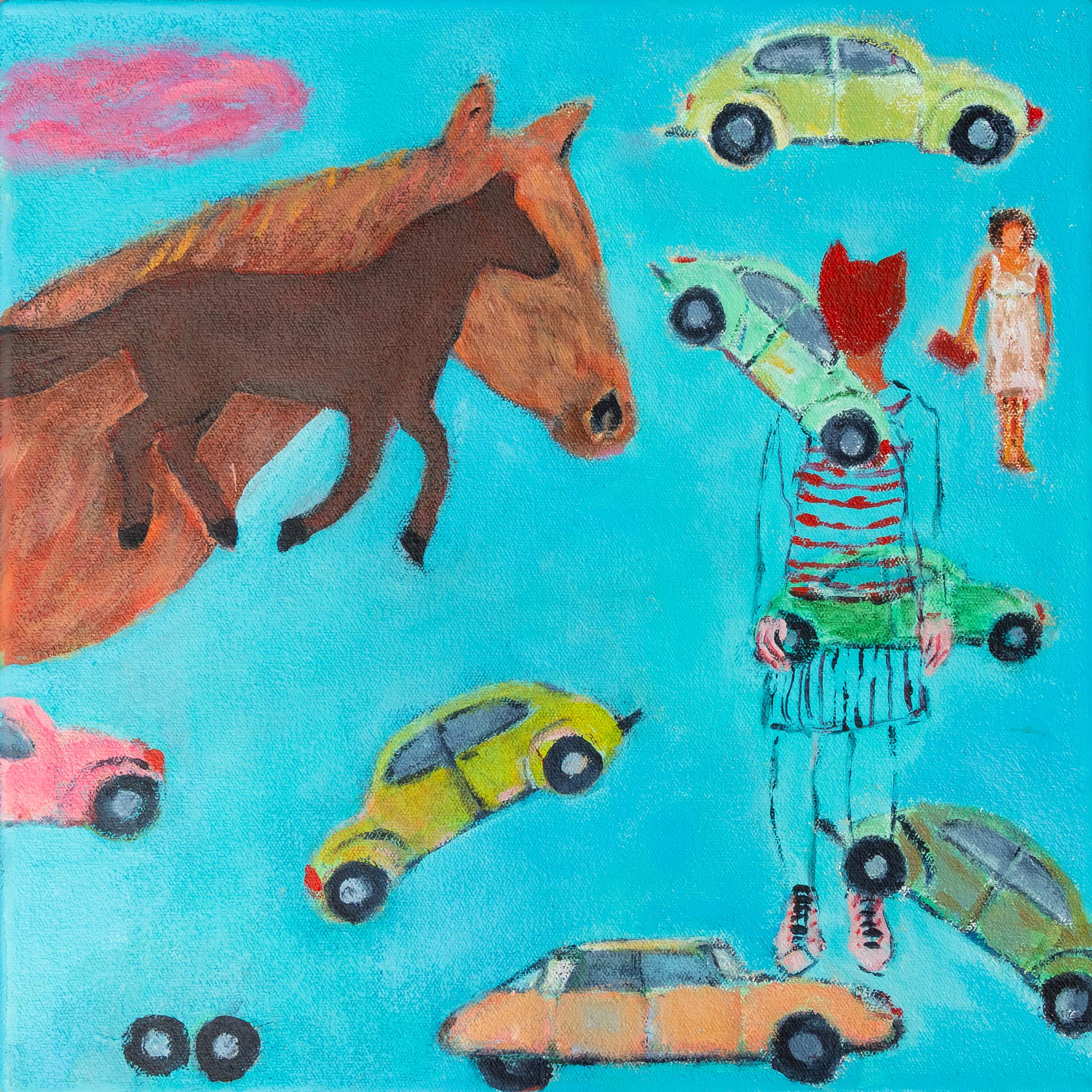
“Horsepower” brings two very different kinds of movement into conversation. A horse dominates the composition, while cars, simplified figures and repeated forms introduce the mechanical world around it. Rather than depicting speed directly, Diana creates energy through rhythm, positioning and the relationships between the different elements. The horse becomes more than an animal here: it carries ideas of strength, freedom and vulnerability, while the title invites us to reconsider what power and movement might mean.
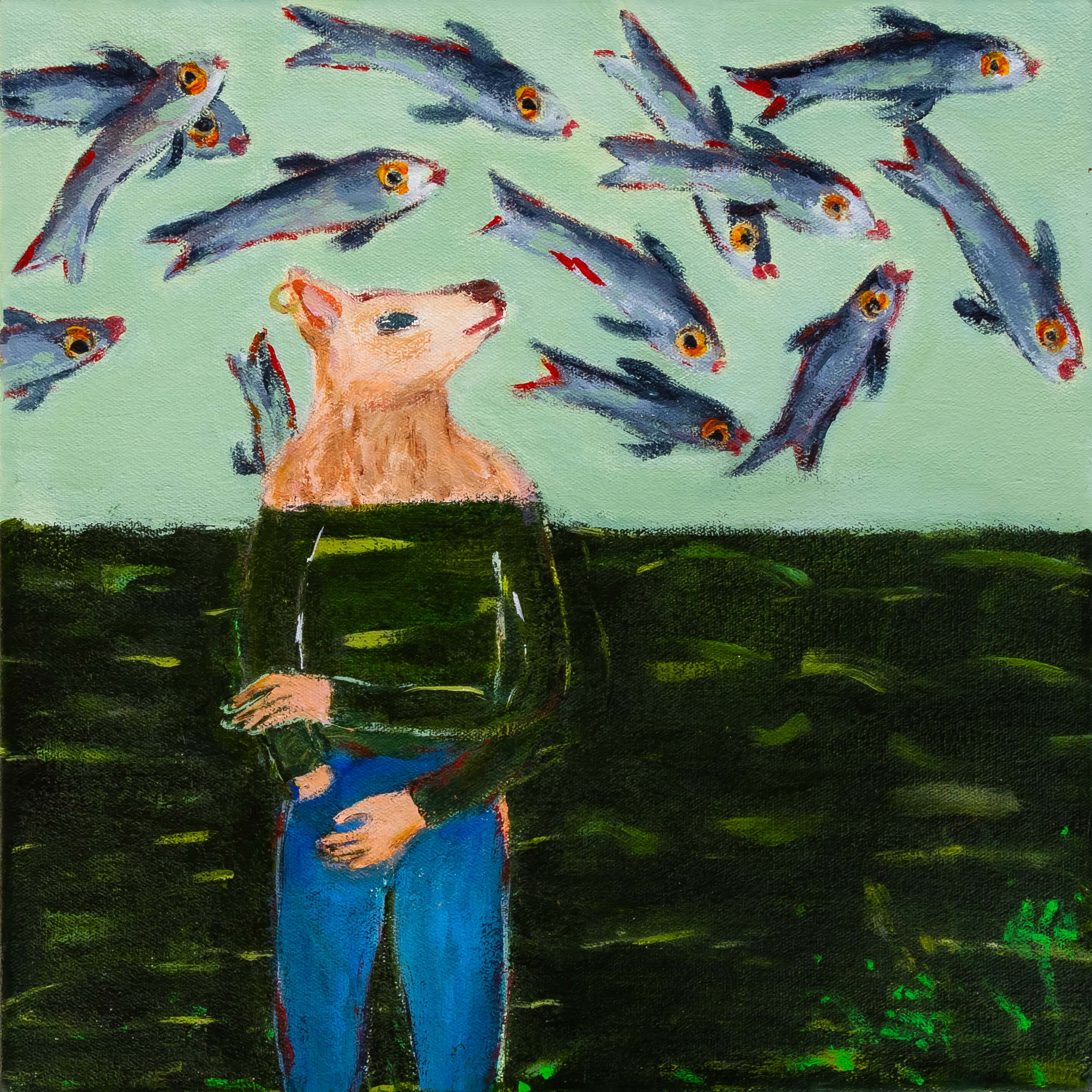
Fish out of Water fills a pale mint sky with a school of grey-blue fish, each with a bright, glinting eye that seems to look back. Below them an animal-headed figure stands with folded arms, half-sunk in dark green, its face tilted up as if watching and being watched in turn. Diana Hyslop often lets animals stand in for herself, and with sky and water reversed, it is unclear who is out of place, the observer or the observed.
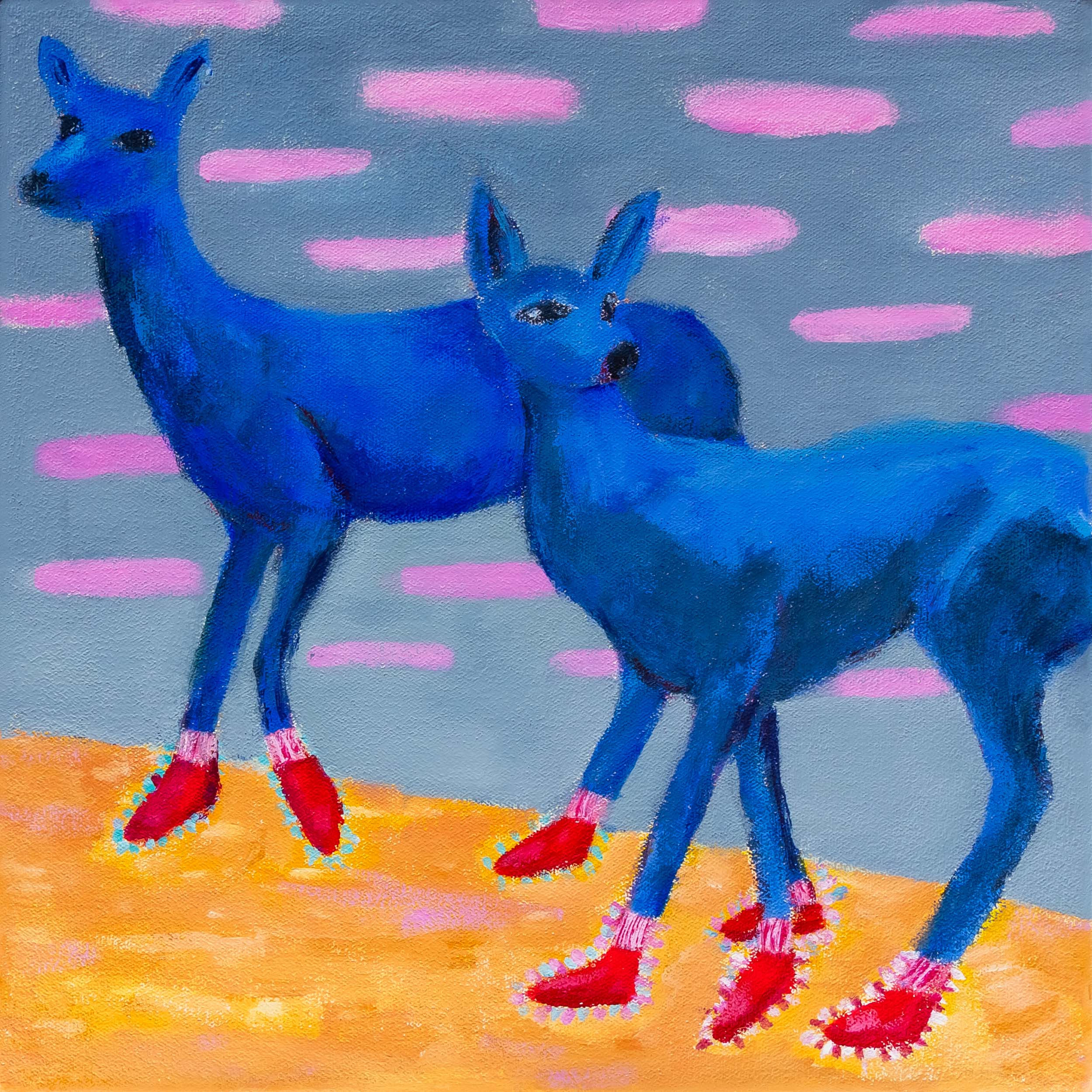
“Tread Softly” places two bright blue deer on an orange ridge beneath a grey sky dotted with pink clouds. Each wears a pair of red slippers trimmed with frills and pale socks, as if they had been told to step carefully and taken the instruction literally. One looks away into the distance; the other turns its head with an open mouth, caught between speaking and holding back. Diana Hyslop’s animals often stand in for herself, and here the reversed, artificial colours make a gentle scene feel tense, a landscape where caution has become costume.
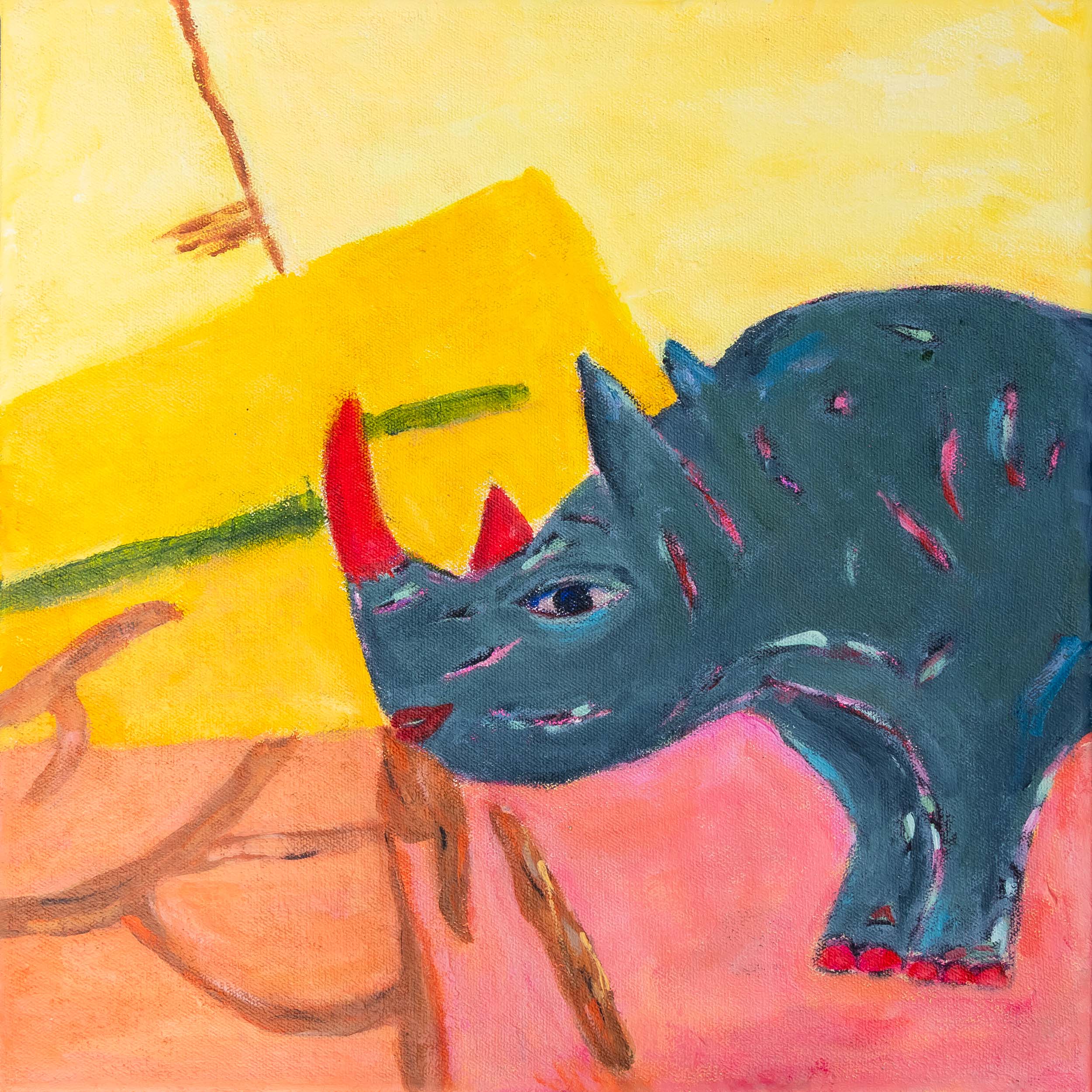
“Rhino in the Sun” began when sunlight cast branching shadows across an earlier rhino painting in Diana Hyslop’s studio. She recreates that moment in radiant blocks of yellow and coral, against which the blue-grey animal takes on a solid, physical presence. Yet this solidity is unsettled by the red horn and sharp pink marks cutting across its body, evoking the violence and vulnerability of rhino poaching. Small, closed red lips, a recurring symbol in Hyslop’s work, suggest speech withheld through fear of judgement. Colour makes the image immediately alluring, while these details bring in a quieter sense of threat and silence.
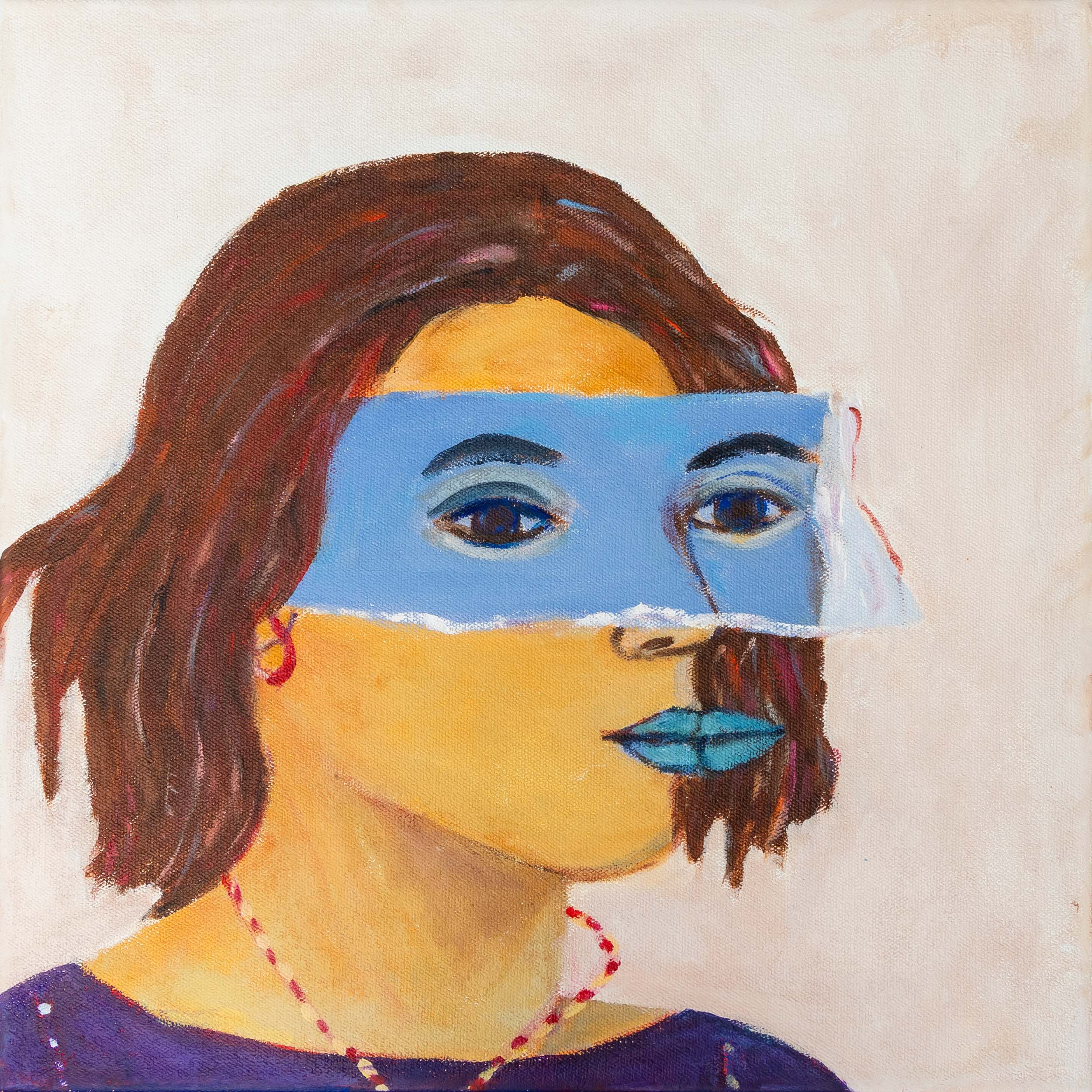
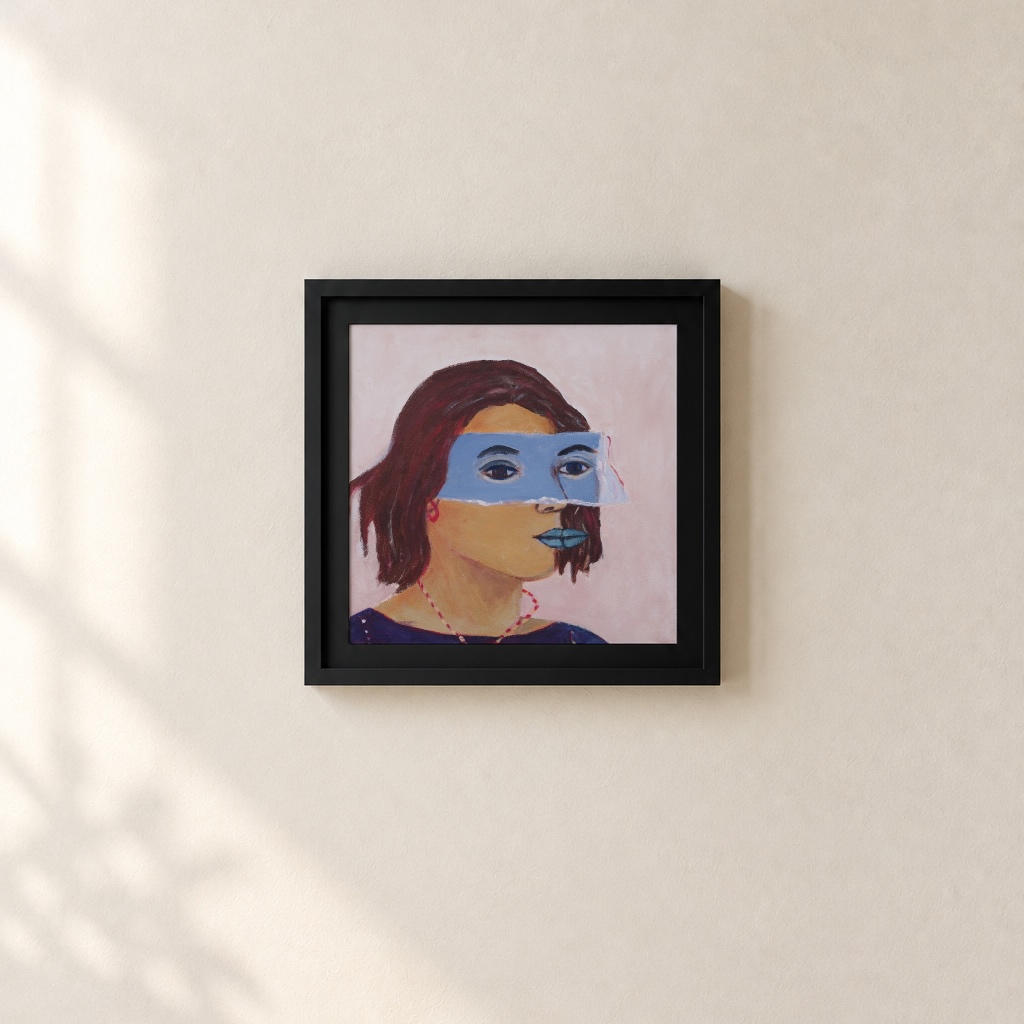
“Watching” began as a portrait of a woman in Diana’s studio, but the face has been fragmented and rearranged into something closer to a painted collage. Its cut-out-like forms recall magazine imagery, Dada composition and Cubist portraiture, while the flashes of red in the lips and nails lend the figure a character that feels at once coy and slightly cruel. There is also something intriguingly self-directed in the gesture—as though the subject is absorbed in the act of watching herself.
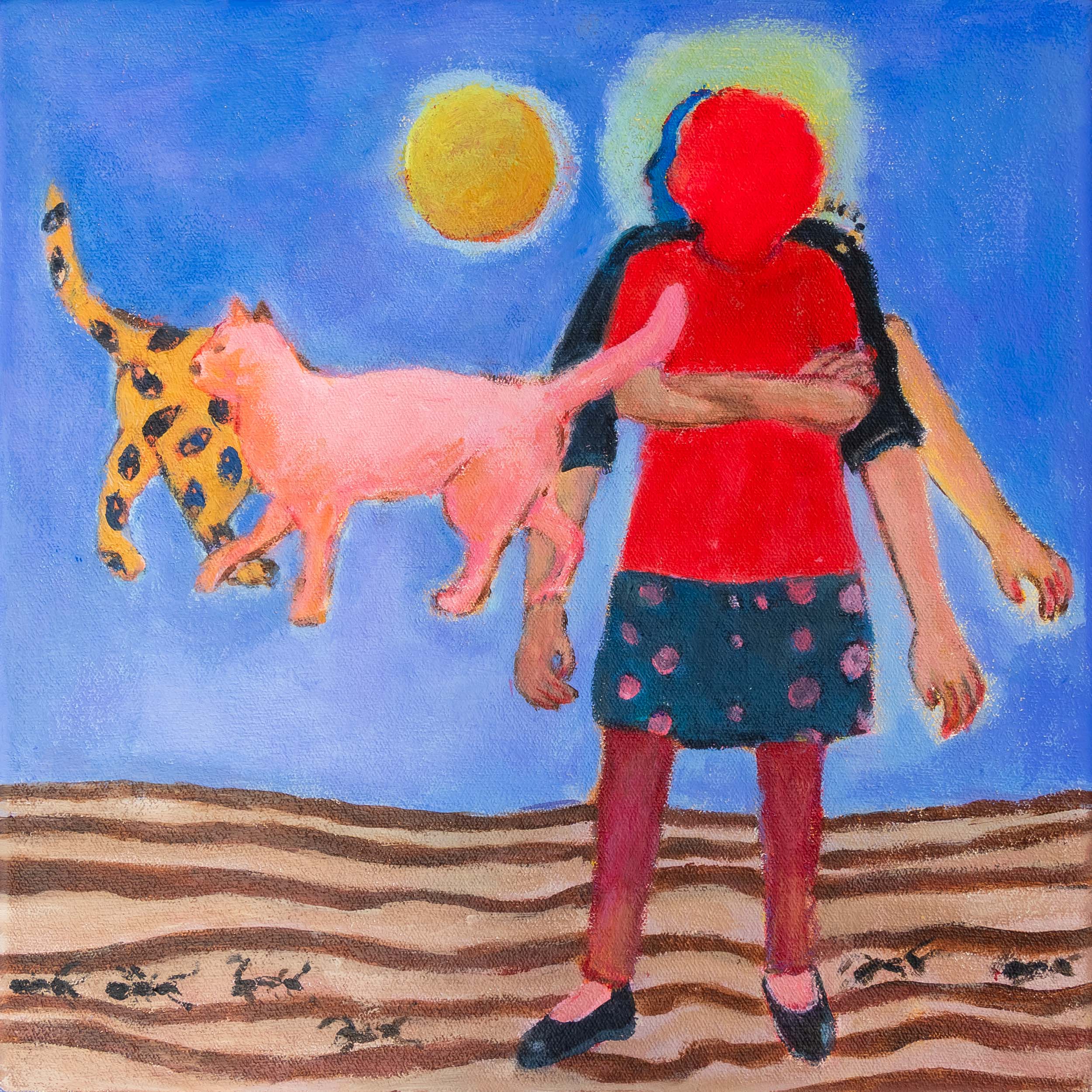
In “From Above”, Diana brings human figures, cats, leopard markings, repeated eyes and protective presences into a composition that seems to occupy several pictorial planes at once. Like a storyboard, the painting offers fragments of a narrative without telling us precisely how they fit together. The eye moves continually between its characters and symbols, discovering relationships that remain open to interpretation—and may shift each time we return to the work.
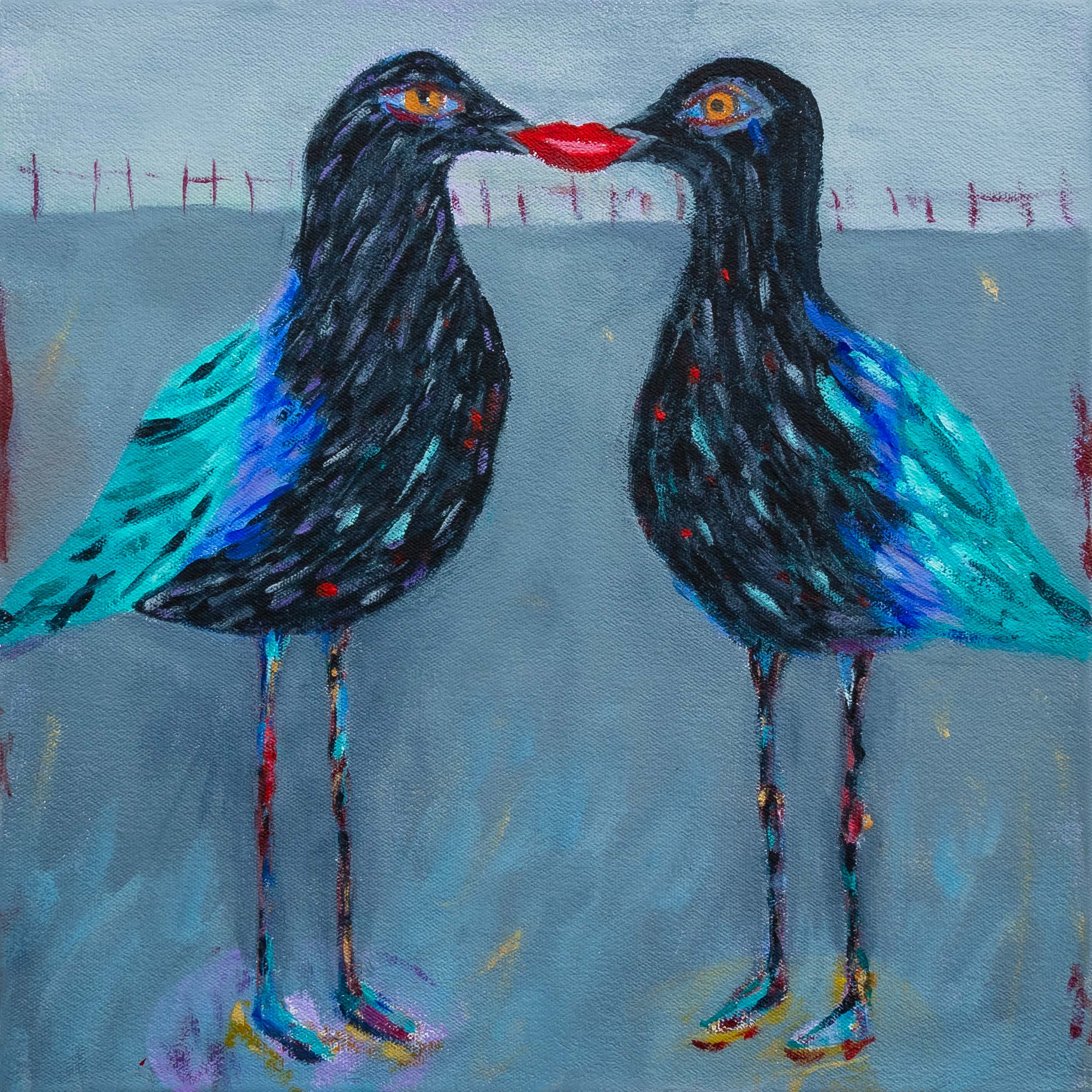
“The Kiss” depicts two birds meeting in a tender, mutual encounter, their dark bodies enlivened by luminous passages of blue, turquoise and purple. Behind them, a distant fence introduces a quiet tension between protection and confinement, while the birds’ capacity for flight suggests freedom and release. Drawing on Diana Hyslop’s recurring use of birds as messengers, the painting evokes closeness, reconciliation and reunion while preserving the imaginative openness that characterises her work.
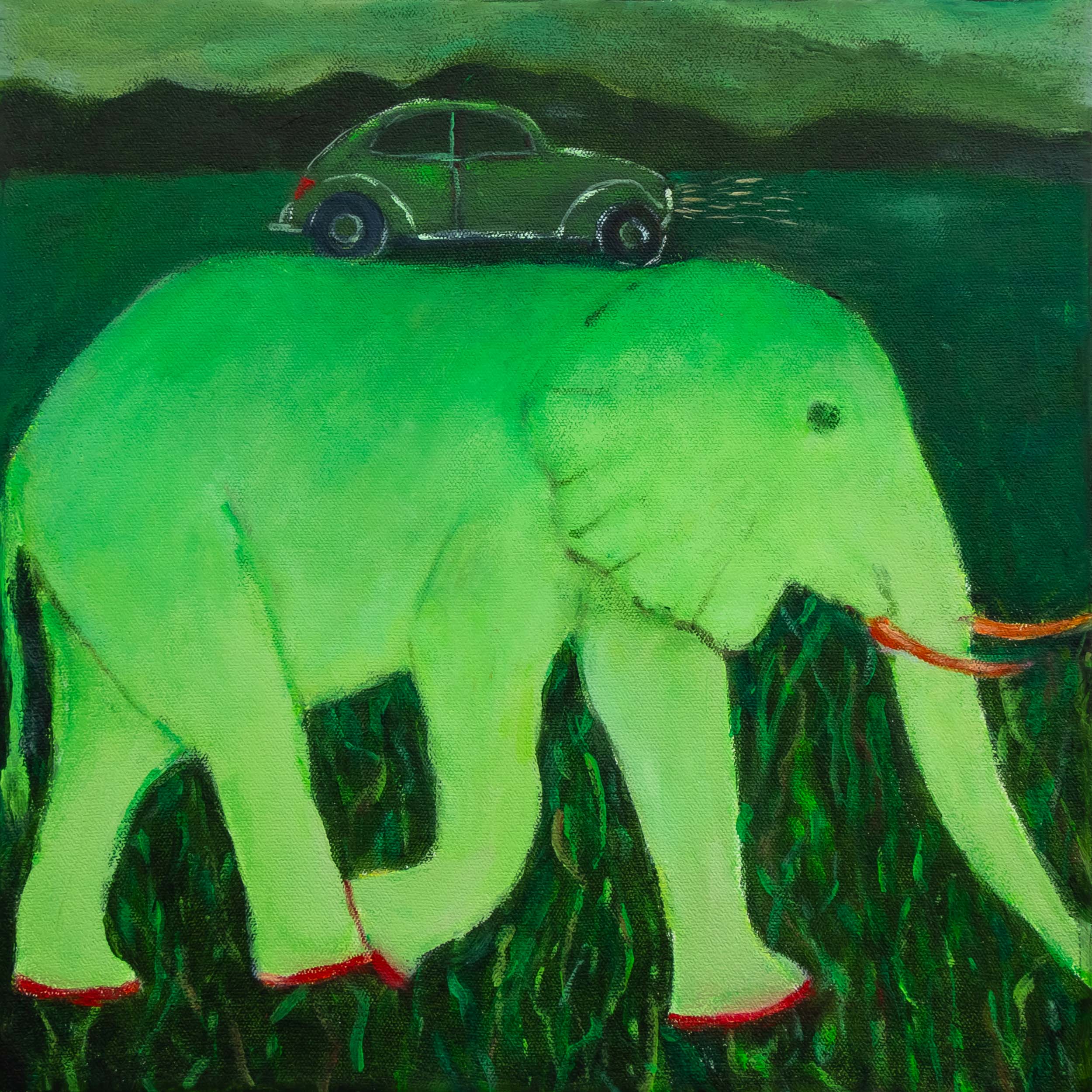
In The Silence of the Elephant, a Volkswagen Beetle sits atop the elephant’s back, its rounded silhouette echoing the animal’s form as both move in the same direction. Yet the pairing also creates a striking contrast between the implied noise of the car and the elephant’s near-silent passage. Drawn from Diana Hyslop’s memories of elephants arriving unexpectedly in the bush at dusk, the fluorescent-green scene balances wonder with latent danger, while the cropped trunk and tusk suggest a story continuing beyond the canvas.