


Year of Birth
Nationality
Location
Social
Descended from a Portuguese family that had to flee Portugal for economic reasons linked to the Salazar dictatorship, and originally from the village of Perais (Beira Baixa), Sonia Martins Mateus develops work rooted in history, territory, and their memory. She is interested in the traces left by displacement, individual and collective narratives, popular cultures, and pagan mythologies.
Through her work collecting materials, documents, and testimonies, her art takes various forms—performances, drawings, textile sculptures, photographs, and landscape sculptures (installations). They appear as traces of a personal and collective history, of a culture that is both popular and universal. This work exudes a unique poetry, traversed by a tension between gentleness and brutality, an in-between space where our relationship to our origins, whether familial, geographical, or social, is replayed.
Her visual language is dry and arid, rocky and scorched. The materials she uses come from construction and domestic spaces, revealing a particular attention to what constitutes and shapes our living environments.
Influenced by the concepts of entropy and landscape, she works from the specificity of sites and their materiality. She pays close attention to the pollution of our territories, whether visual, material, or symbolic, and questions the slow or violent transformations of inhabited spaces.
Her palette is organic and primitive. Attached to black, she creates through and with it. She attacks the material using fire, acid, or bleach, in a gesture of burning and revelation. Black is bitten, transfigured, allowing other colors to emerge: ochre, shades of gray, yellows, oranges, and off-whites. Her compositions engage in a conversation with notions of space, territory, and material, organic, and architectural stratification. They question the very notion of landscape: what can be defined, what it contains, and what it produces.
Taking an interest in popular cultures and construction practices by referring to those who build—rather than those who design, finance, or orchestrate—is a way of challenging the standardization of architecture. This art of building too often excludes residents from all phases of design and construction. It is also a way of promoting a heritage other than that of the powerful: a heritage of popular practices, gestures, and customs.
After studying history, she enrolled at ESAM Caen/Cherbourg, where she graduated with honors in 2019. After several exhibitions in France and residencies, she was awarded a residency at the Cité Internationale des Arts in 2022 and also created a visual and sound performance at the Musée des Beaux-Arts in Caen. Following her first international exhibition, The Invisible Thread, at the AVA Gallery in Cape Town, South Africa, she was invited to perform in Bern during the summer season of 2023.
Working in Normandy in a studio at the Le Bazarnaom art factory, she develops cultural action projects with local residents in collaboration with various institutions (socio-cultural center, nursing home, National Education).
At the same time, she will return in 2025 to a part of the small South African desert for a creative and research residency, as well as for two exhibitions, DIEPE GROND / Klein Karoo National Kunst (KKNK) and FROZEN TALES/AVA Gallery/Cape Town. Invited by the Modern Art Project South Africa [MAPSA] foundation and selected for the KKNK 2026, she returned to South Africa to continue her research and creative work, this time in the heart of the great South African desert.
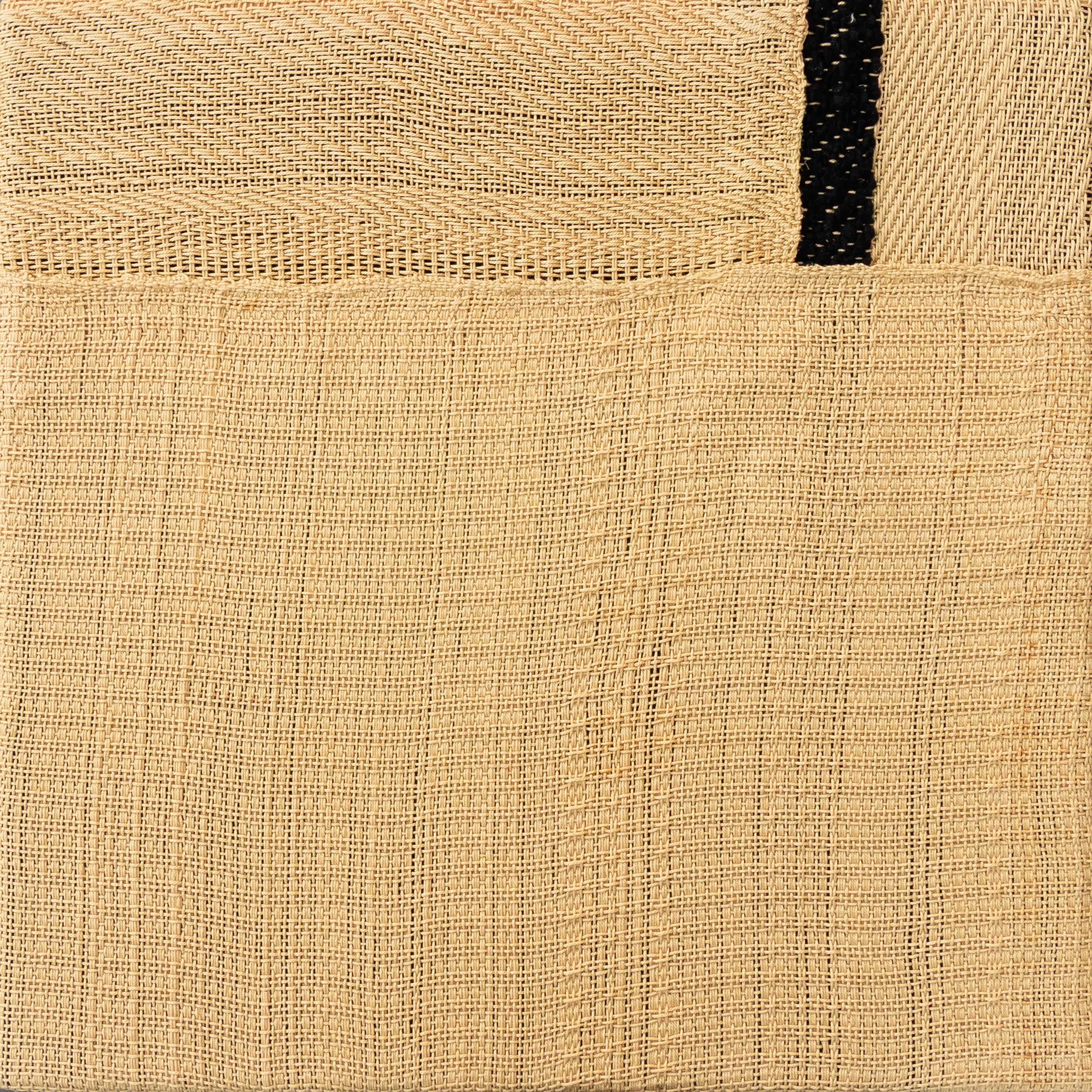
“Spatialisation I” is handwoven in yellow ochre and black cotton thread and stretched over a wooden frame. A sheer, open-weave layer overlaps the lower part of the square like a folded edge, while above it herringbone and twill passages run in different directions, broken by a narrow vertical band of black. Because the thread changes direction from zone to zone, the surface seems to shift as the viewer moves in front of it. Sonia Martins Mateus builds her compositions in layers, thinking about how architecture, figures and organic elements are placed within a landscape, and here that idea is distilled into planes, edges and thresholds of thread. Small irregularities in spacing and tension keep the artist’s hand visible, and the work enlarges the woven structure that a painted canvas usually hides, making it the subject rather than the support.
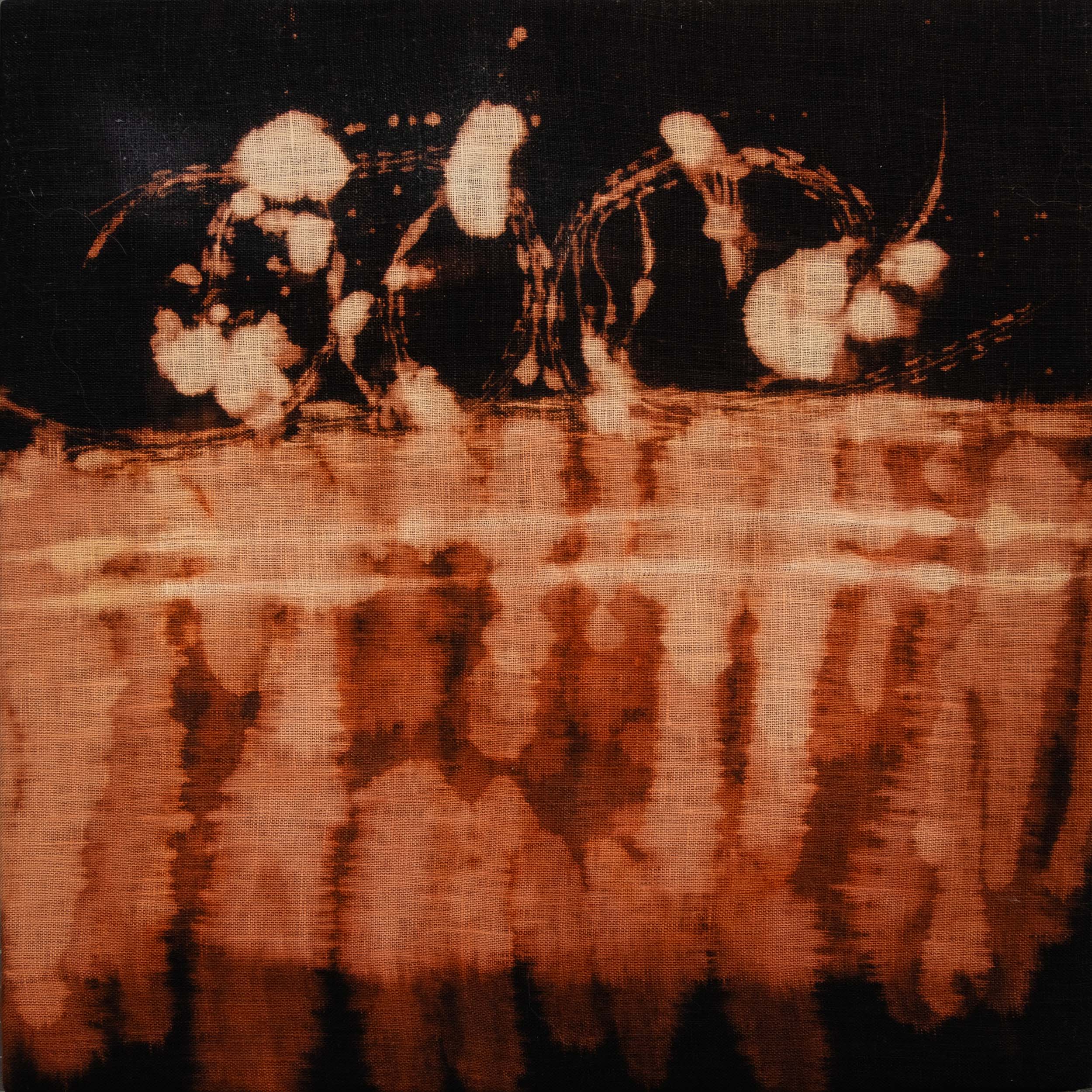
Sonia Martins Mateus’ Plastic Birds is made through painting bleach on black linen, where the image is revealed by removing, biting into, and transforming the surface rather than adding colour to it.
The work holds a compressed, frontal space. Pale ochre forms rise out of the dark ground, while looping, wire-like marks and a dense horizontal structure create a feeling of blockage or containment. The black remains active throughout the image, so that even the areas of light seem to carry shadow beneath them.
Across Martins Mateus’ practice, landscape is not only a place to look into, but a structure shaped by memory, territory, displacement, and material force. In Plastic Birds, that question becomes direct: the painting offers an image, but also resists entry.
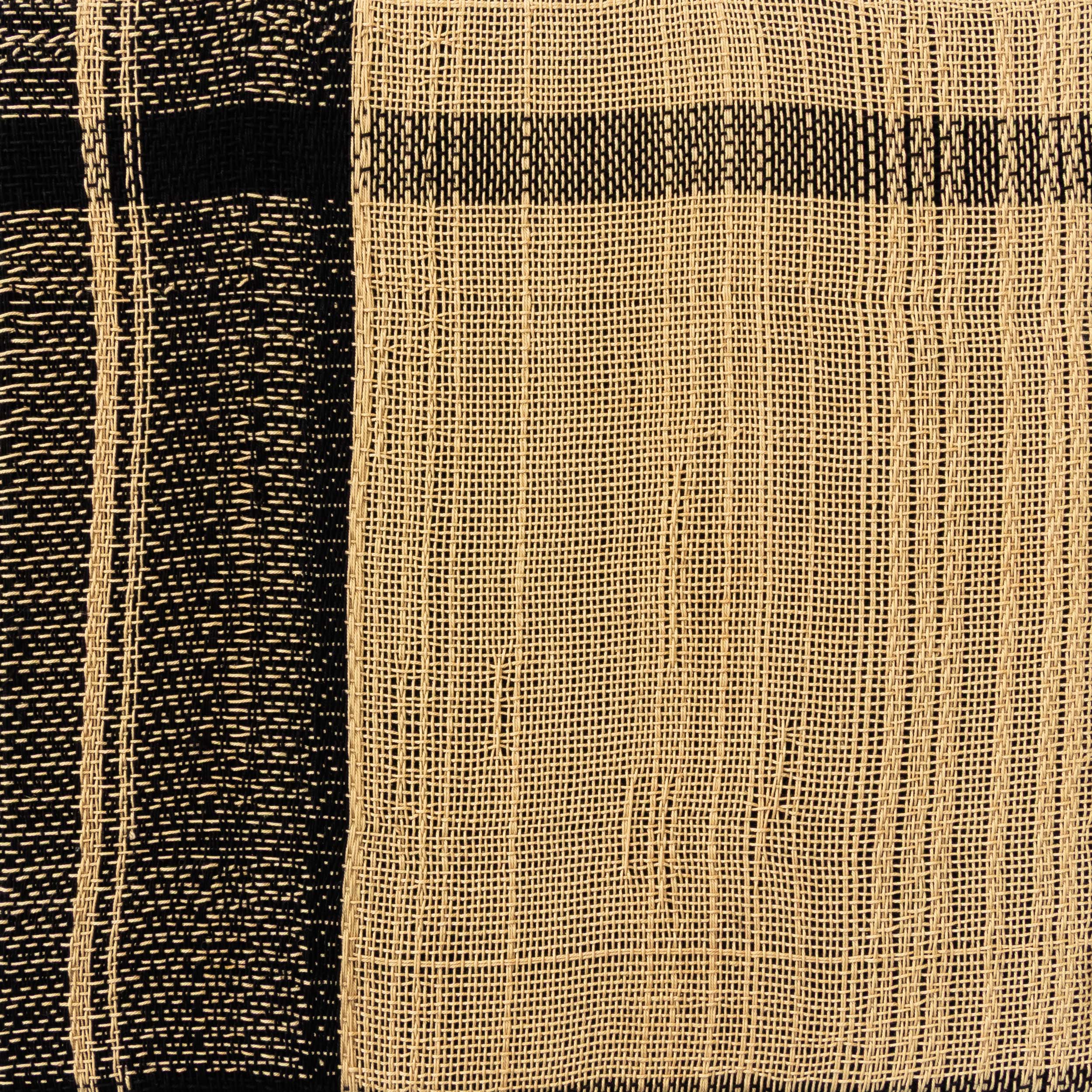
“Spatialisation IV” turns the landscape idea that runs through Sonia Martins Mateus’s work towards the horizon. Broad black bands stretch across a dense field of ochre and black thread like strata of earth or the lines of a distant terrain, while a frayed seam at the left edge leaves the loose ends of the weave exposed. Thread is treated as paint here, built up in layers, with every variation in spacing and tension left visible, so that the hidden structure of canvas becomes the image itself.
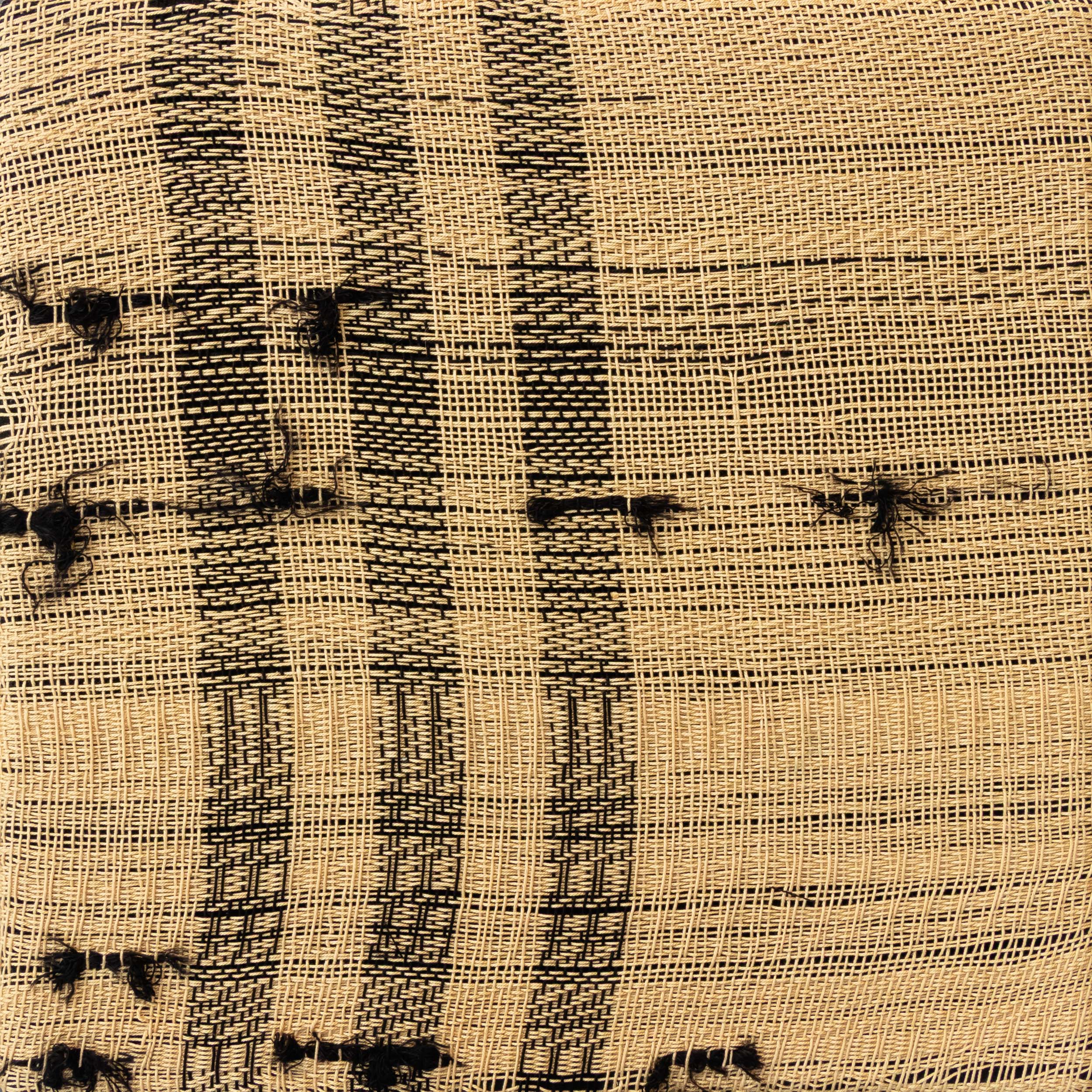
“Spatialisation II” is handwoven in yellow ochre and black cotton thread on a wooden frame. Three tall black bands rise through an open, gauze-like weave, their dense patterning loosening into ladder-like structures towards the bottom. Fine black lines run horizontally across them, and small tufts of loose thread are knotted into the surface, their frayed ends left visible.
These gathered ends bring forward what a weaver would normally conceal at the back of the work, turning the unfinished into a deliberate mark. Sonia Martins Mateus builds her compositions in layers, and here the bands and scattered tufts read almost as architectural forms and organic growth set within a pale landscape of thread. Slight variations in spacing and tension keep the artist’s hand present throughout, and the work magnifies the structure of canvas itself, making the woven ground the subject rather than the support.
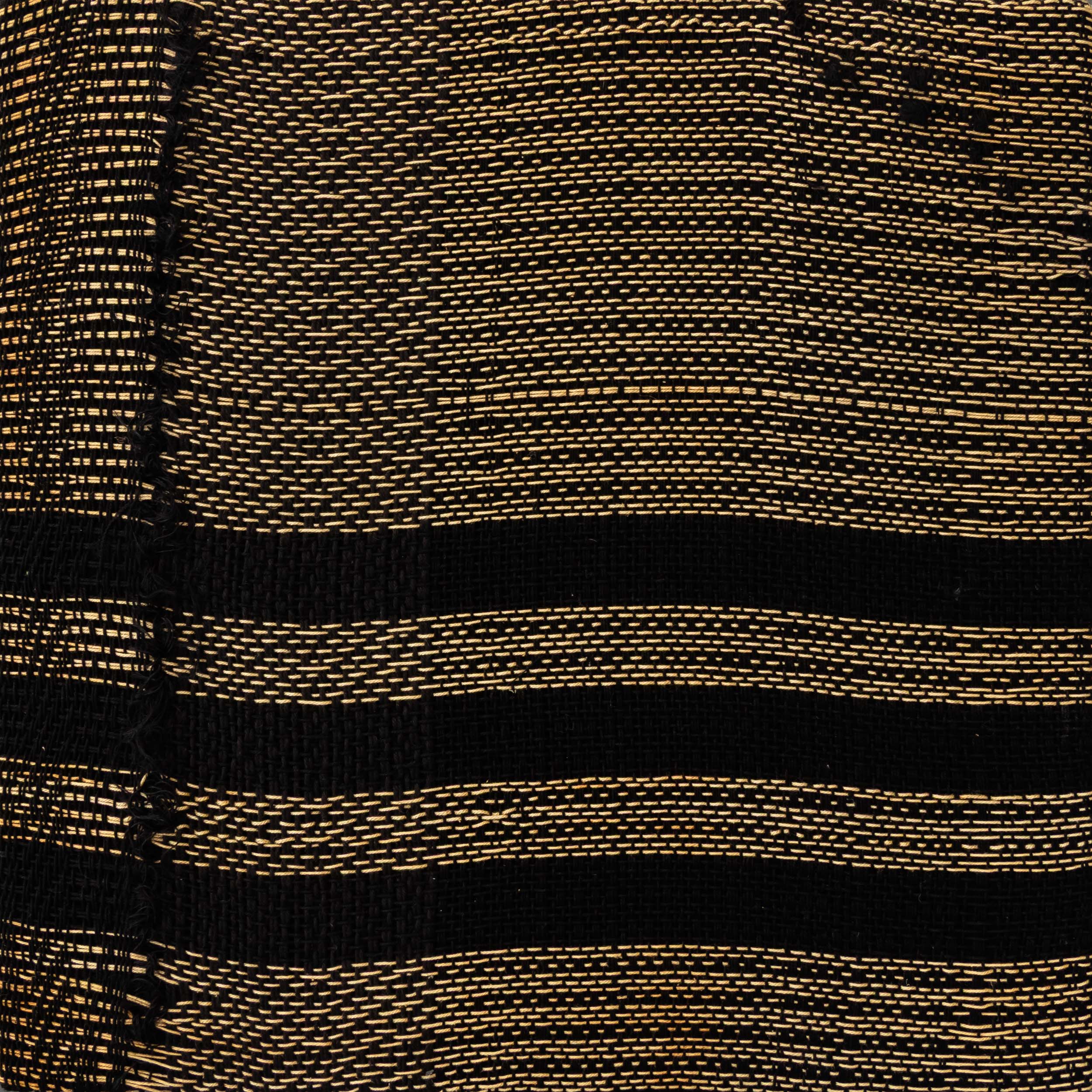
“Spatialisation III” grows out of Sonia Martins Mateus’s interest in how people, architecture and organic elements are placed within a landscape. Working with thread as others work with paint, she builds the composition in layers, setting a dense, dark weave beside an open, translucent one so that the two read like solid and void, or built form and open ground. The handwoven structure, usually hidden beneath a painted image, becomes the subject itself, with every irregularity of spacing and tension left visible.
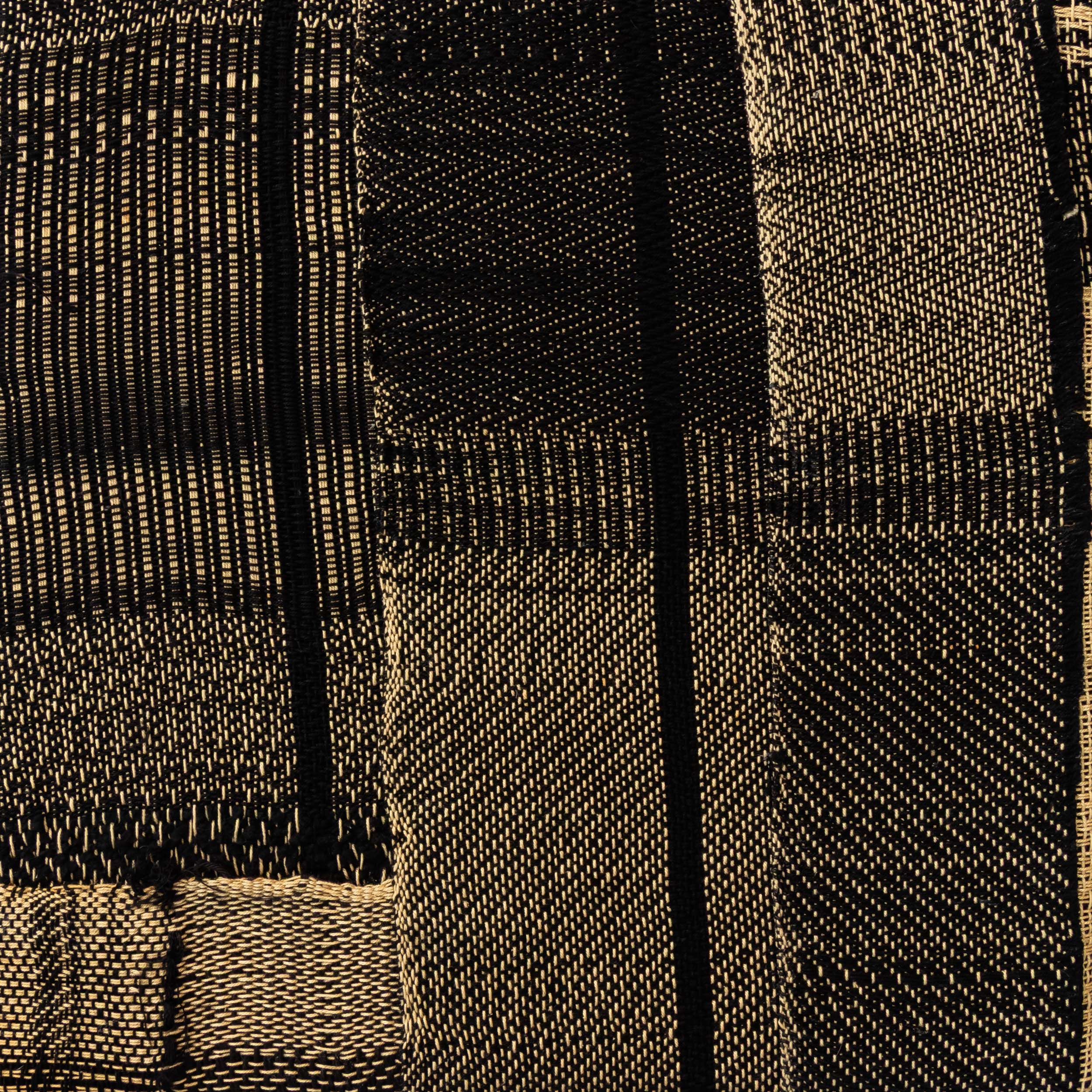
“Spatialisation V” is the most architectural of Sonia Martins Mateus’s series, a patchwork of woven blocks in ochre and black thread, each turned in a different direction. Herringbone, diagonal twill and fine vertical striping meet at hard edges, while a single black line runs down the centre like a beam or a doorway. The blocks read as rooms, walls and plots of land seen from above, a plan in which built form and open ground are pieced together, the idea of spatialisation that runs through her work. Because the thread changes direction from one block to the next, the surface seems to shift as the viewer moves, and the visible seams and small irregularities of tension keep the hand of the weaver present.