
Salon is designed to help you trust your eye when collecting art. Explore the collection, choose the works that resonate with you, and let the deeper meaning behind your instinctive response reveal itself as you live with the work.
Tommaso Fattovich,
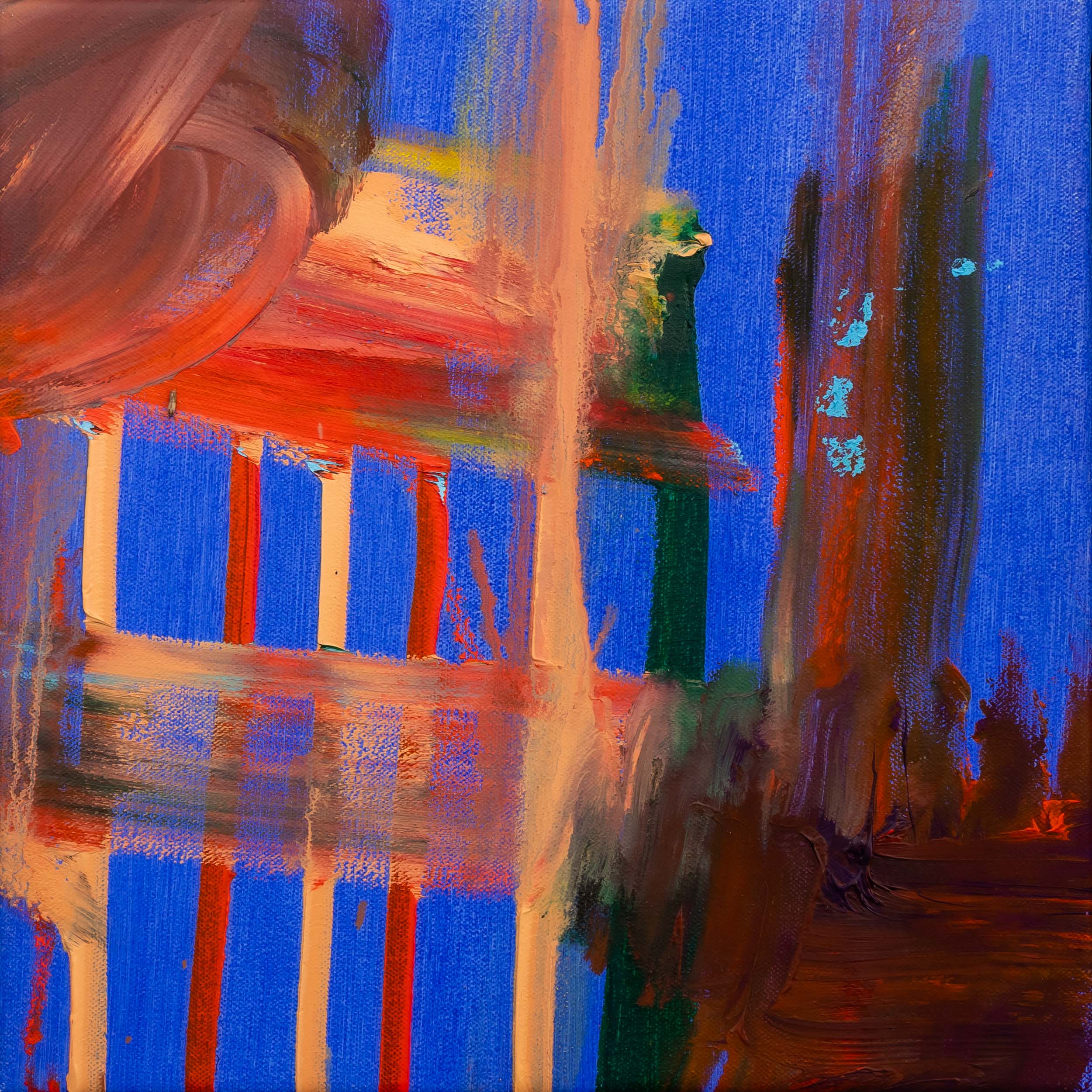
Birds On A Wire 1 brings together force and suspension. Thick, earthy strokes gather at the edges of the composition, while pale vertical passages and a vivid blue ground open pockets of space within the painted surface.
The work retains the urgency of Fattovich’s large-format process. Rather than beginning from a small canvas, he works at scale and then isolates selected sections, allowing each crop to become a new compositional decision.
Here, the tension lies in how movement is held in place. Gestures seem to push across, fall through, or collect against one another, giving the work a sense of something still in motion, even after the surface has settled.
Tarik Chebl,
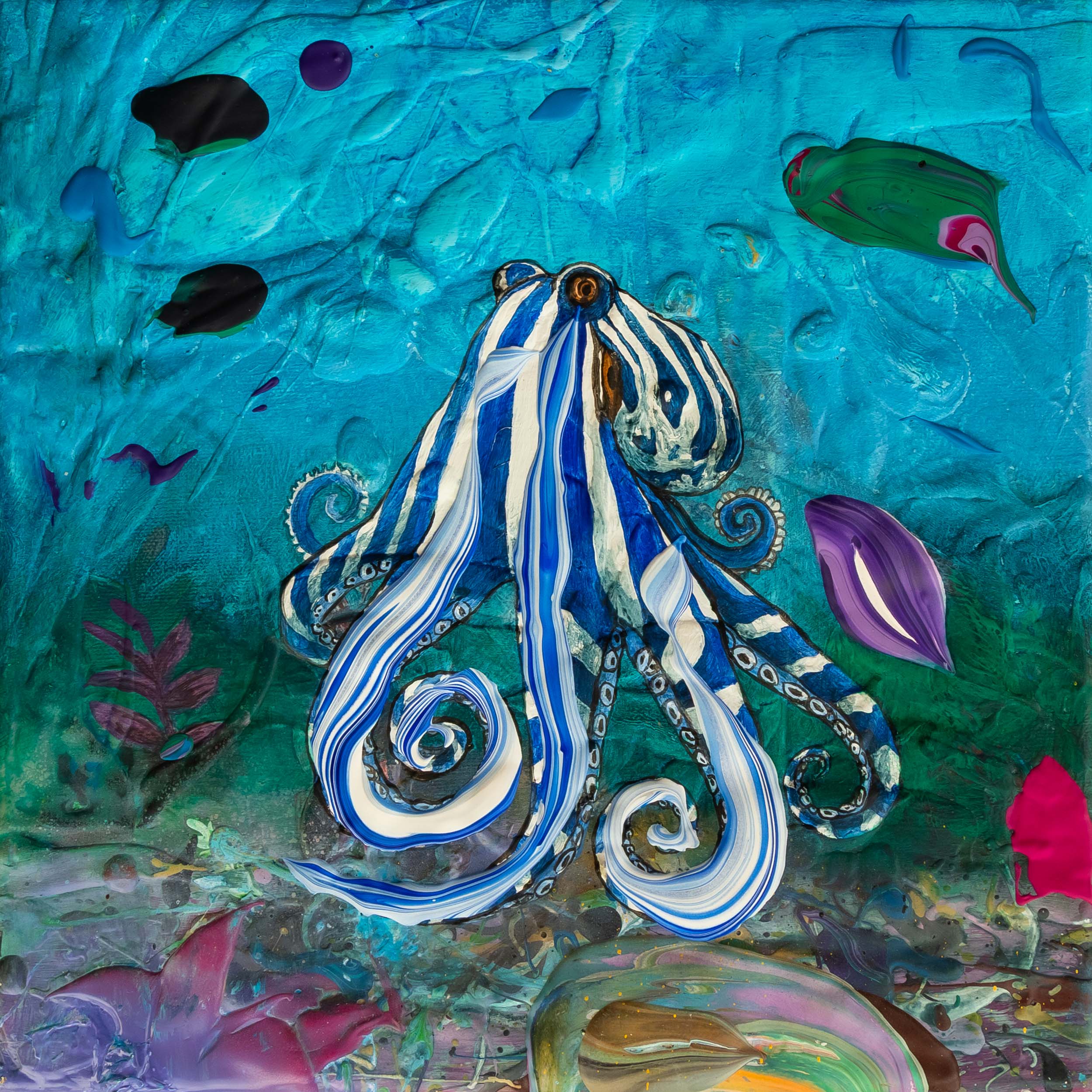
In “Blue Octopus” bold blue-and-white lines articulate the creature’s curling tentacles, giving it a striking graphic rhythm and almost calligraphic grace. Thickly applied paint lends the octopus a vivid physical presence, while other raised passages appear partially obscured by the water, creating the illusion of forms suspended at different depths. Against a scraped and layered field that descends from luminous blue into deeper green, the octopus emerges with the clarity of a portrait, surrounded by an underwater world that remains strange, dense and only partly knowable.
Tommaso Fattovich,
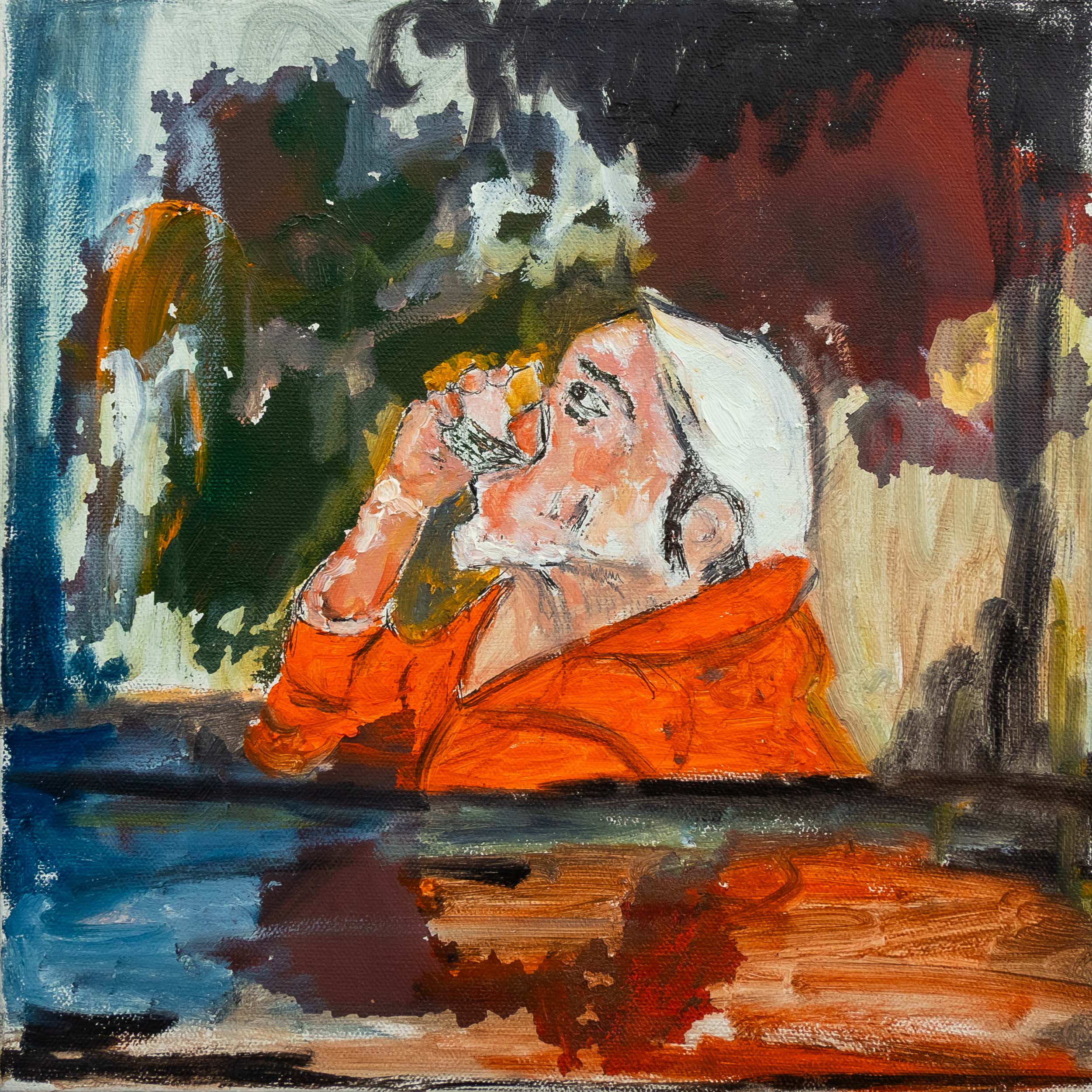
Osteria II is built through layers of addition and removal, beginning with an older oil painting partially covered in white acrylic. Tommaso then draws the figure in pencil, lifts sections of the acrylic with industrial tape to reveal the earlier painting beneath, and adds further oil paint to soften and disrupt the boundaries between figure and background. The result is a compressed, unstable space in which the seated figure feels both present and partially dissolved, hovering between observation and memory.
Tarik Chebl,
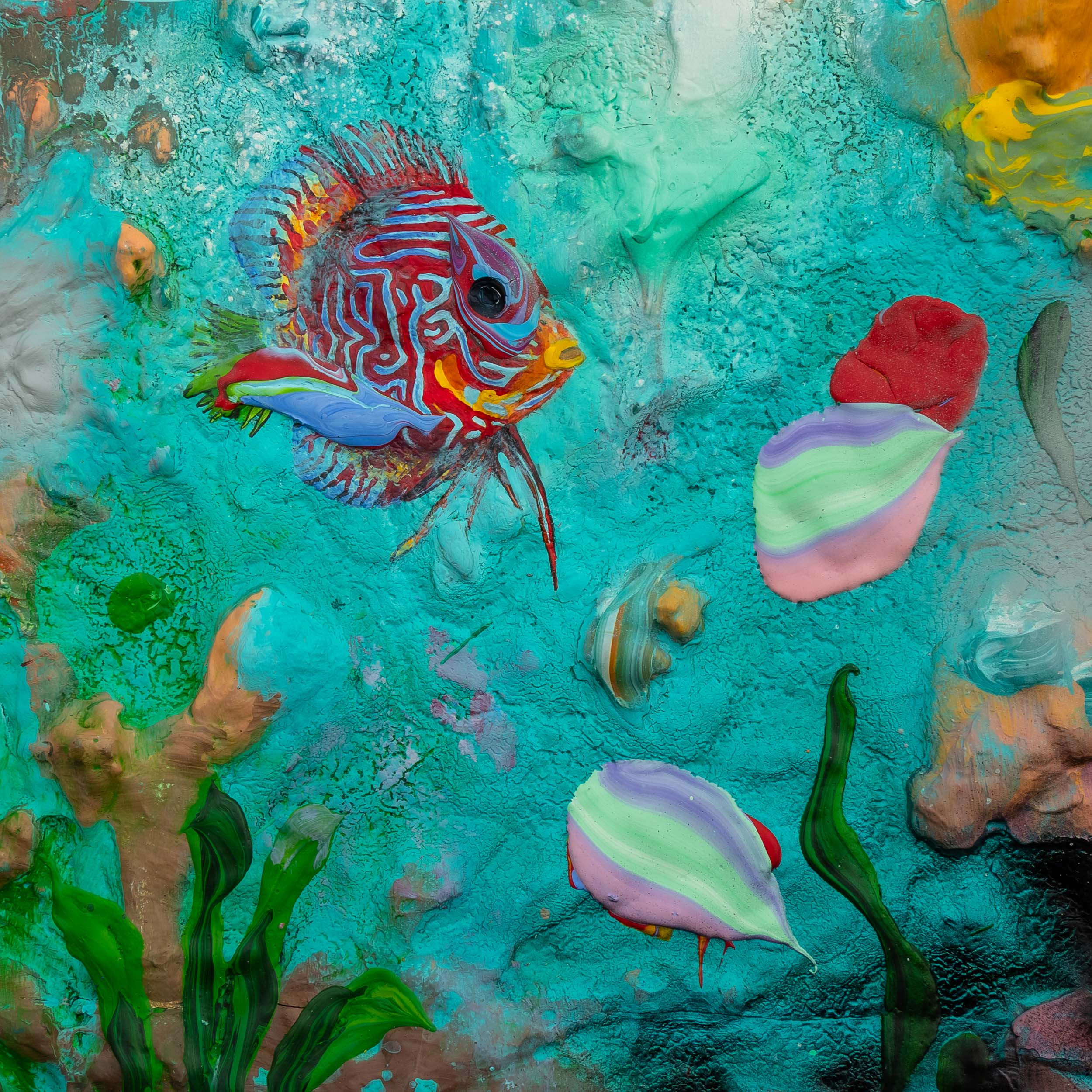
“Discus” depicts a vividly patterned fish emerging from a densely built-up, almost volcanic surface. Its body shifts between clarity and concealment—partly sculptural, partly translucent and partly absorbed into its surroundings—suggesting both camouflage and display. The fish’s watchful eye gives the painting a quietly disconcerting presence, as though the act of looking is being returned. Layered colour and relief-like passages of paint allow the work to shift continually between recognisable image and sculptural surface, while the fish’s gaze gives it an arresting sense of life.
Tarik Chebl,
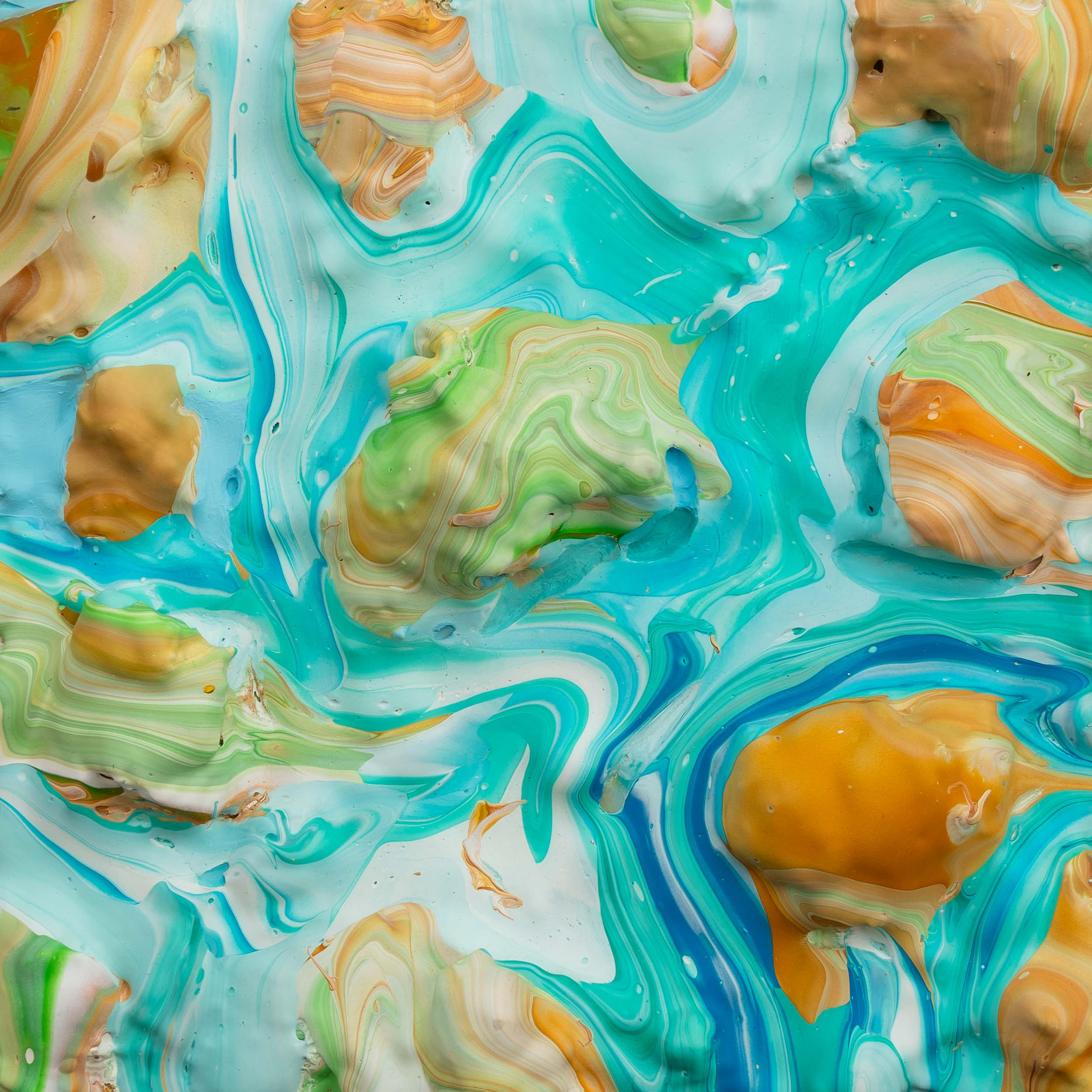
In Island Fragment, Tarik Chebli moves toward a more abstract and object-like language. Poured and accumulated paint creates a dense, topographical surface, where colour and material seem to settle into islands, channels, and geological formations.
Rather than depicting nature directly, the work approaches it through texture, mass, and viewpoint. Seen almost from above, the painting suggests a terrain in formation: part image, part relief, part imagined fragment of an ecological world.
This material intensity sits at the centre of Chebli’s practice, where nature becomes a way to explore paint as substance — layered, physical, and suggestive of mud, water, bark, vegetation, and shifting ground.
Tommaso Fattovich,
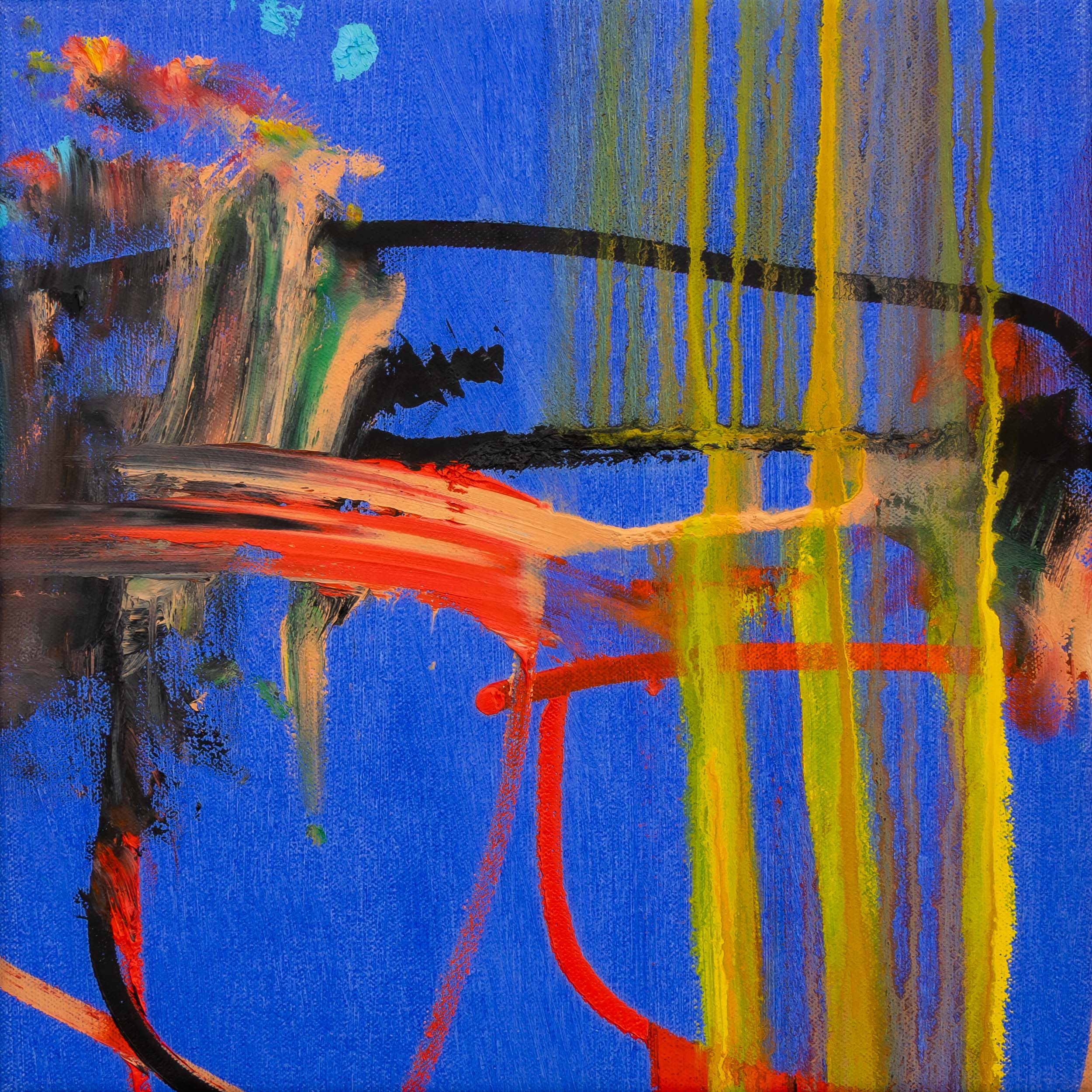
In Birds On A Wire 3, Tommaso Fattovich sets a horizontal sweep of red and pale paint against a vivid blue ground. Vertical drips descend through the composition, while black and yellow marks cut across the surface with a sharper, more graphic force.
The work carries the energy of a larger painting, but its cropped format changes how that energy is read. What may once have been part of a broader field now becomes a concentrated arrangement of speed, interruption and rest.
Fattovich’s process is instinct-led and immersive, shaped by accumulated layers, direct physical action and a willingness to let the painting reveal its own point of completion.
Patrik Dvorščak,
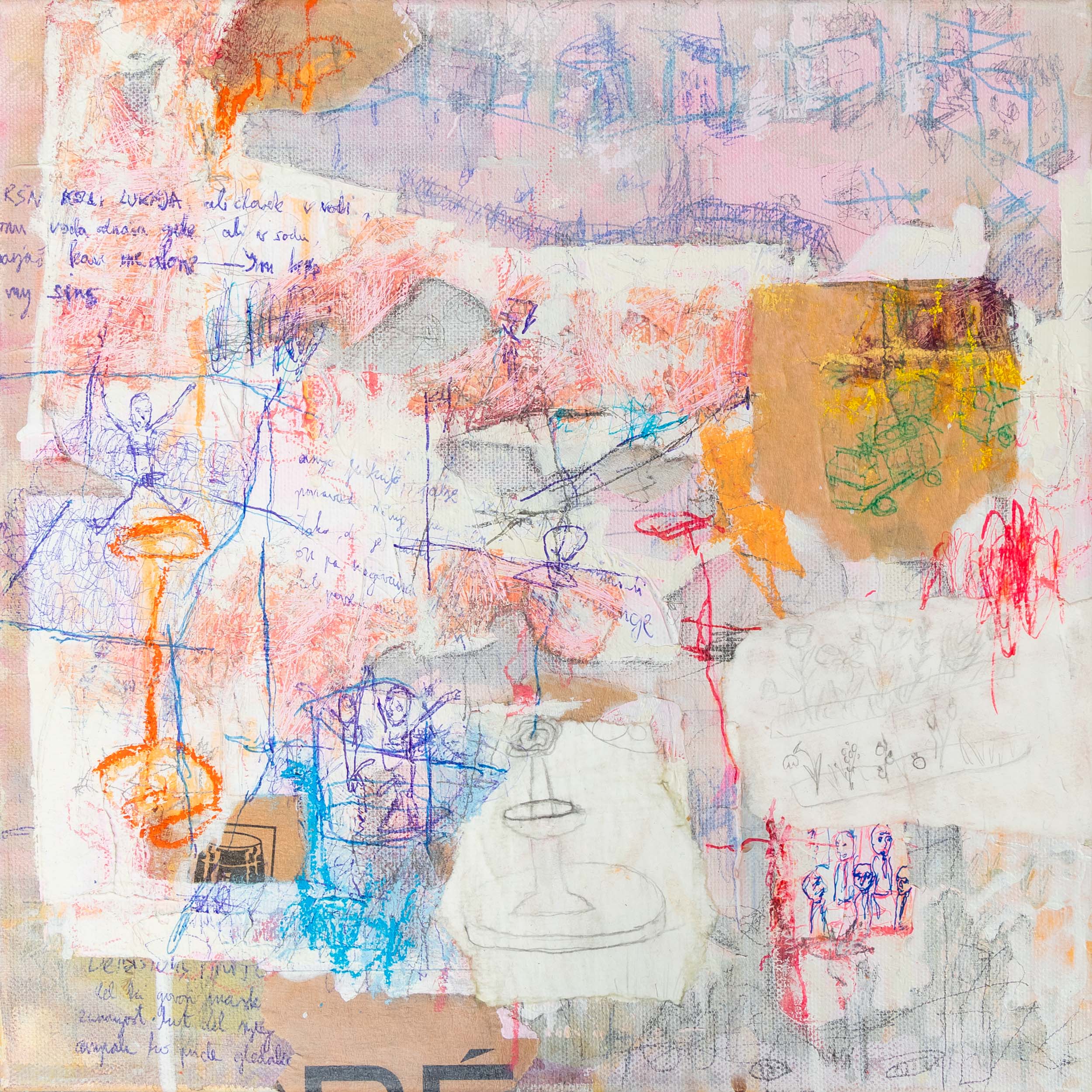
In a “Well or a Void, We Have Fun” packs drawings, handwritten fragments and torn collage come together into a small, dense field. Figures with raised arms balance on taut lines, a pencil-drawn fountain rests on a pale sheet, and a green truck is sketched over a block of cardboard. Each scene is only partly legible, giving the impression of thoughts, memories and social observations arriving at once. Blocks of paper and colour lend the surface structure and depth, while recurring lines and blue ink guide the eye across it. Warm blush tones feel playful at first, but a closer look reveals a compressed, anxious atmosphere.
Patrik Dvorščak turns intuitive mark-making into a psychological space where humour and unease share the same small room.
Tarik Chebl,
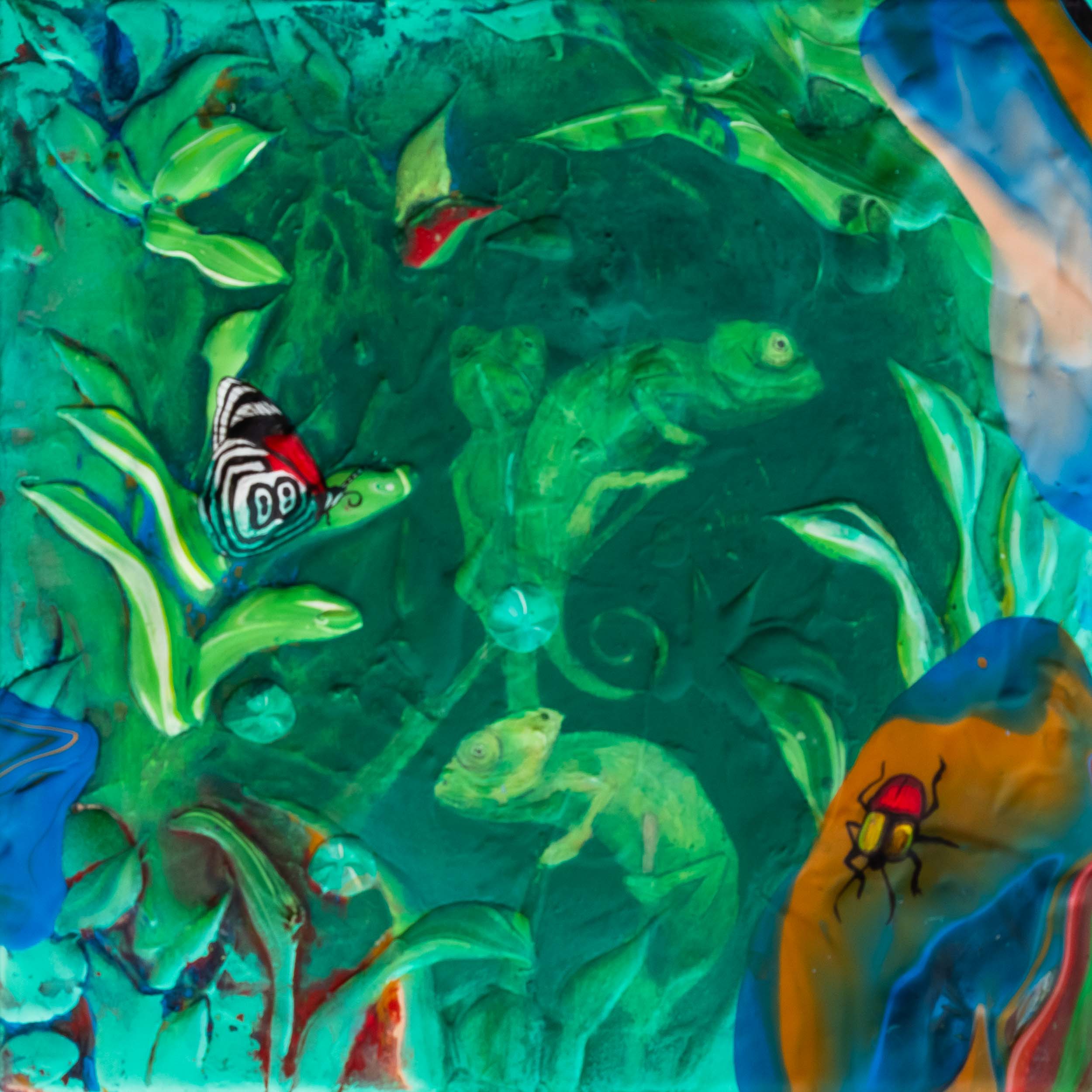
“Chameleons and Cie” is a small ecosystem in which figure and environment dissolve into one another. Two chameleons surface from a dense, jewel-green ground, half-hidden among leaves and sharing their world with a butterfly and a beetle. Tarik Chebli builds the surface from thick layers of acrylic, so the paint becomes terrain, a place of growth and mutation rather than a backdrop. Nature is imagined here free of human presence, vivid and slightly poisonous in colour, beautiful but never quite safe to enter.
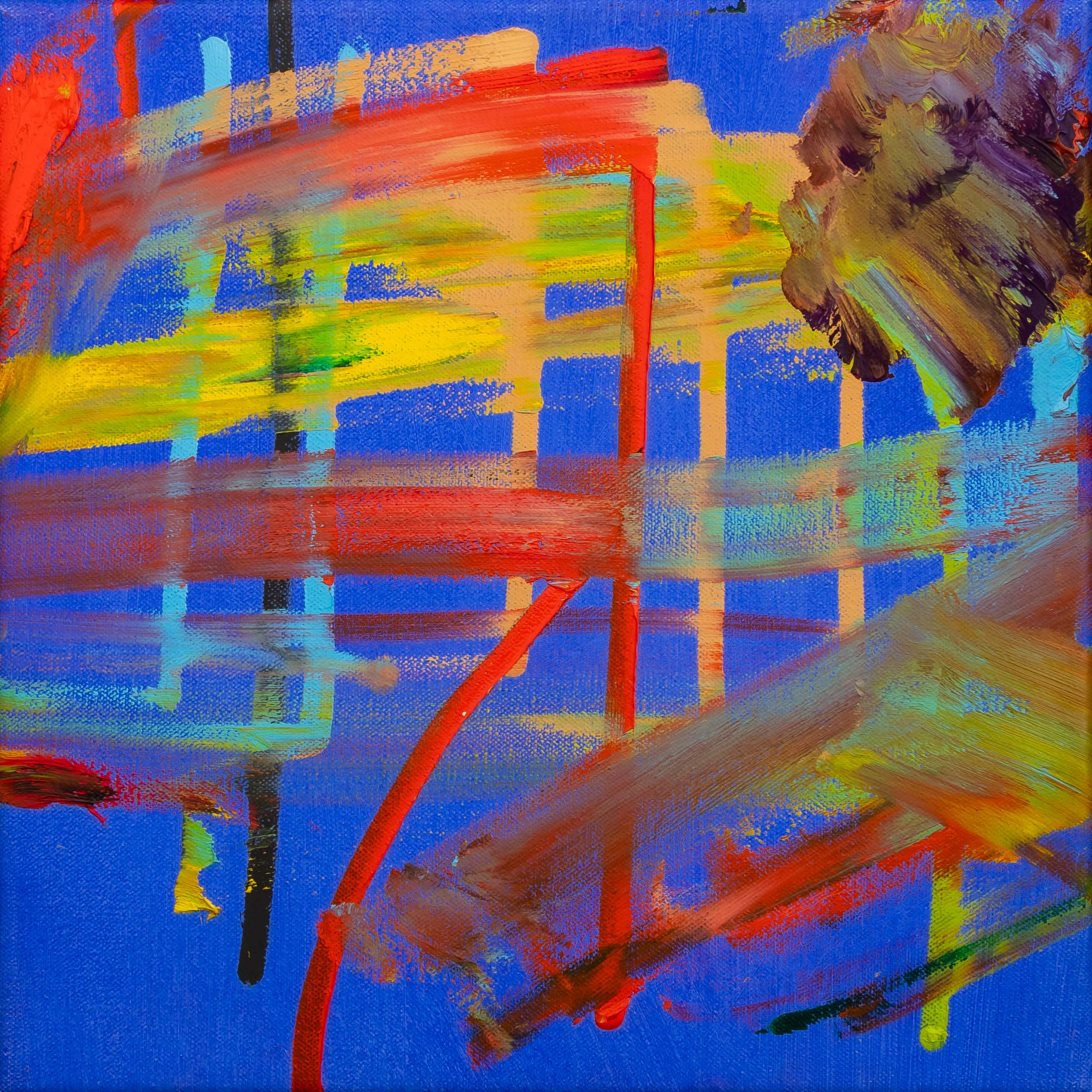
Tommaso Fattovich,
In Birds On A Wire 0, Tommaso Fattovich holds strong colour in a state of movement. A saturated blue field is crossed by bands of red, yellow, green and muted brown, with vertical marks and dragged passages creating a rhythm of interruption and return.
The work comes from a larger canvas, later cut into smaller compositions. That process makes the crop an active part of the work: each gesture has been separated from its original field and asked to carry its own balance, pressure and pace.
Fattovich’s practice is rooted in physical immediacy. His marks are built through instinctive contact with the surface, using paint, tools and the body to arrive at the point where the image begins to hold itself.
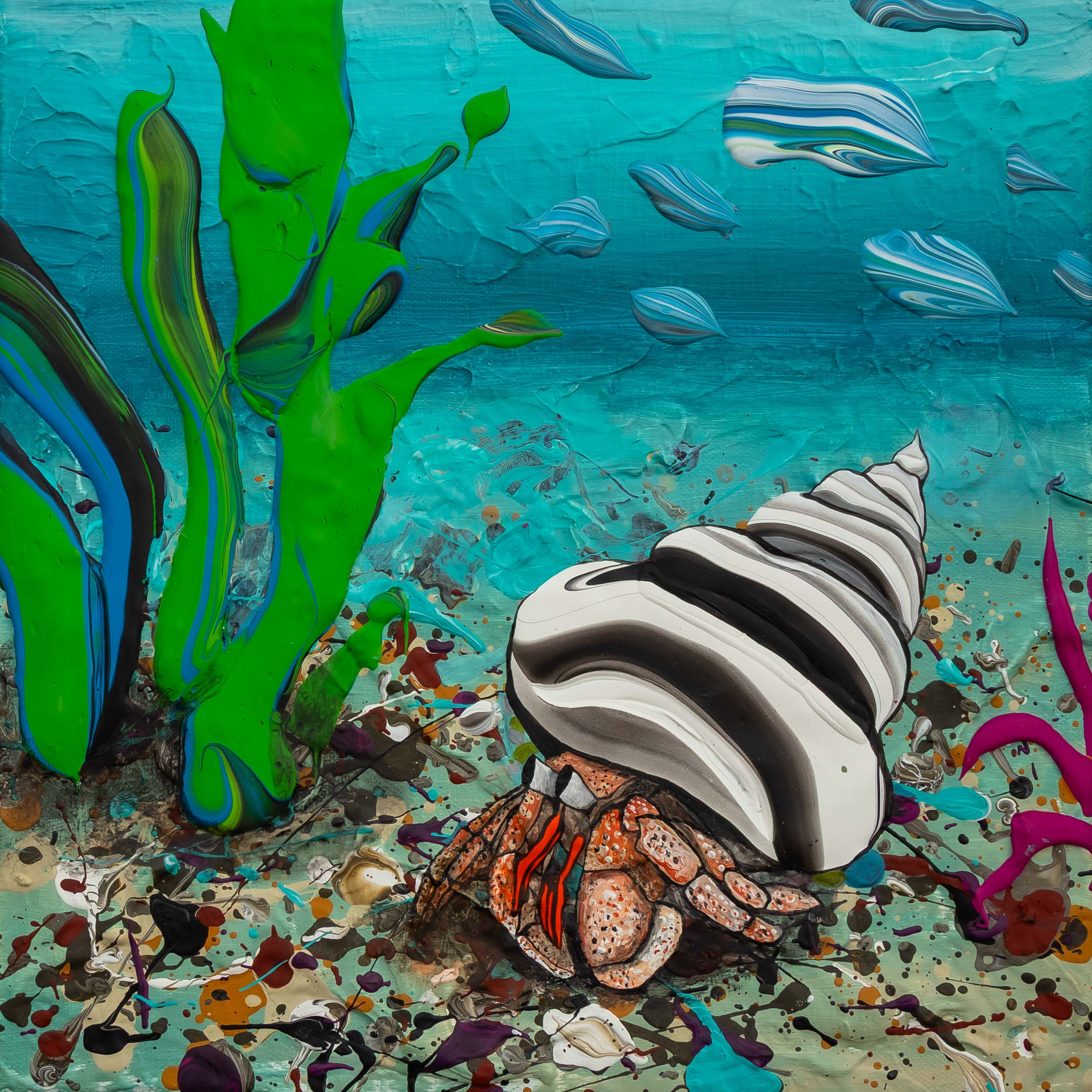
Tarik Chebl,
In Tarik Chebli’s Hermit Crab, the creature sits firmly in the foreground, its striped shell and finely worked body emerging from a dense seabed of marks, splashes, and textured paint. Around it, green plant forms rise through a vivid turquoise field, while small marbled fish-like shapes move across the upper part of the composition.
The work brings together two important parts of Chebli’s practice: close attention to rare or overlooked life forms, and a physical, almost sculptural use of paint. Here, the environment does not simply surround the hermit crab; it seems to hold it, giving the image a clear relationship between figure, ground, and habitat.
Chebli describes his paintings as a way of looking away from the human world and toward imagined ecosystems. In Hermit Crab, that imagined
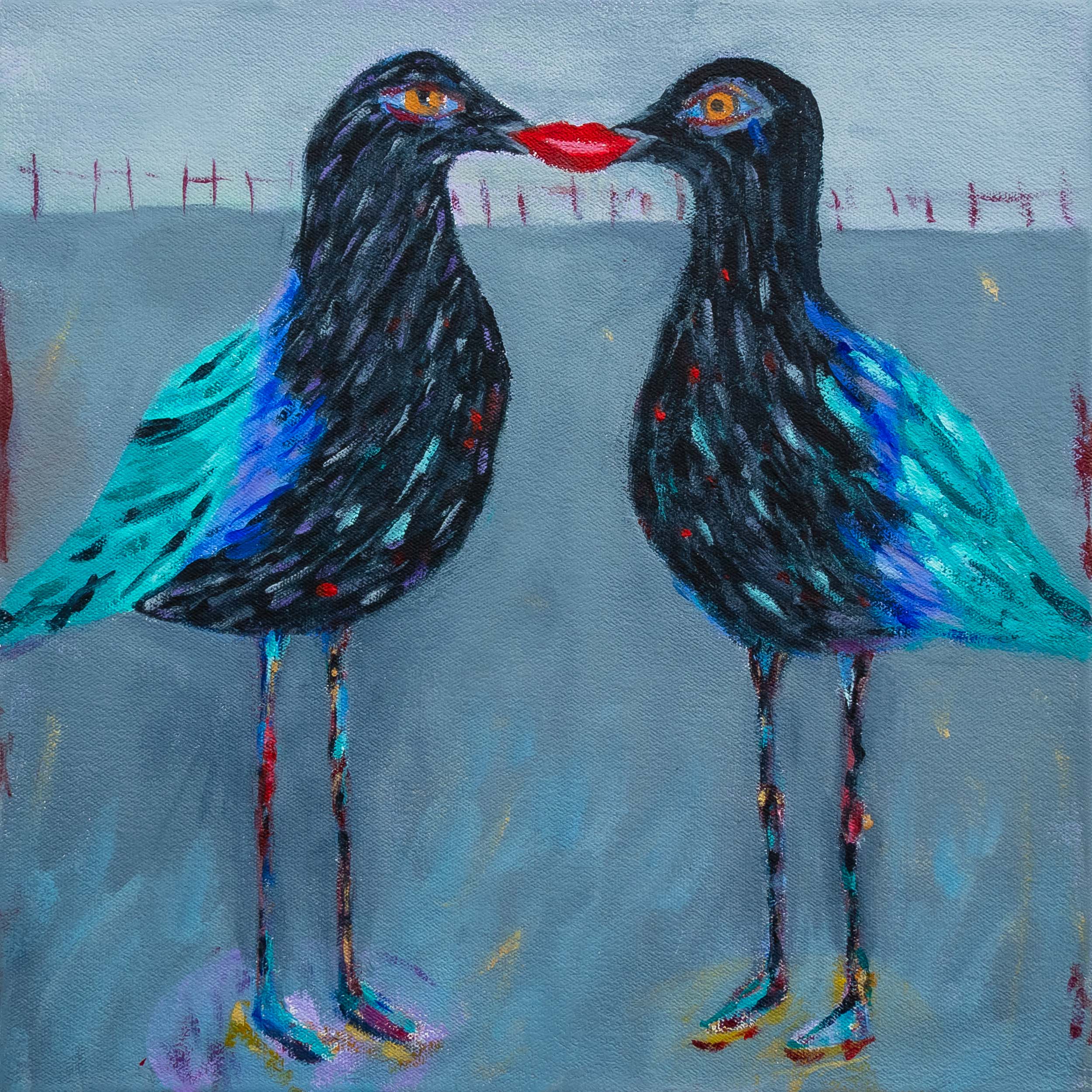
Diana Hyslop,
“The Kiss” depicts two birds meeting in a tender, mutual encounter, their dark bodies enlivened by luminous passages of blue, turquoise and purple. Behind them, a distant fence introduces a quiet tension between protection and confinement, while the birds’ capacity for flight suggests freedom and release. Drawing on Diana Hyslop’s recurring use of birds as messengers, the painting evokes closeness, reconciliation and reunion while preserving the imaginative openness that characterises her work.
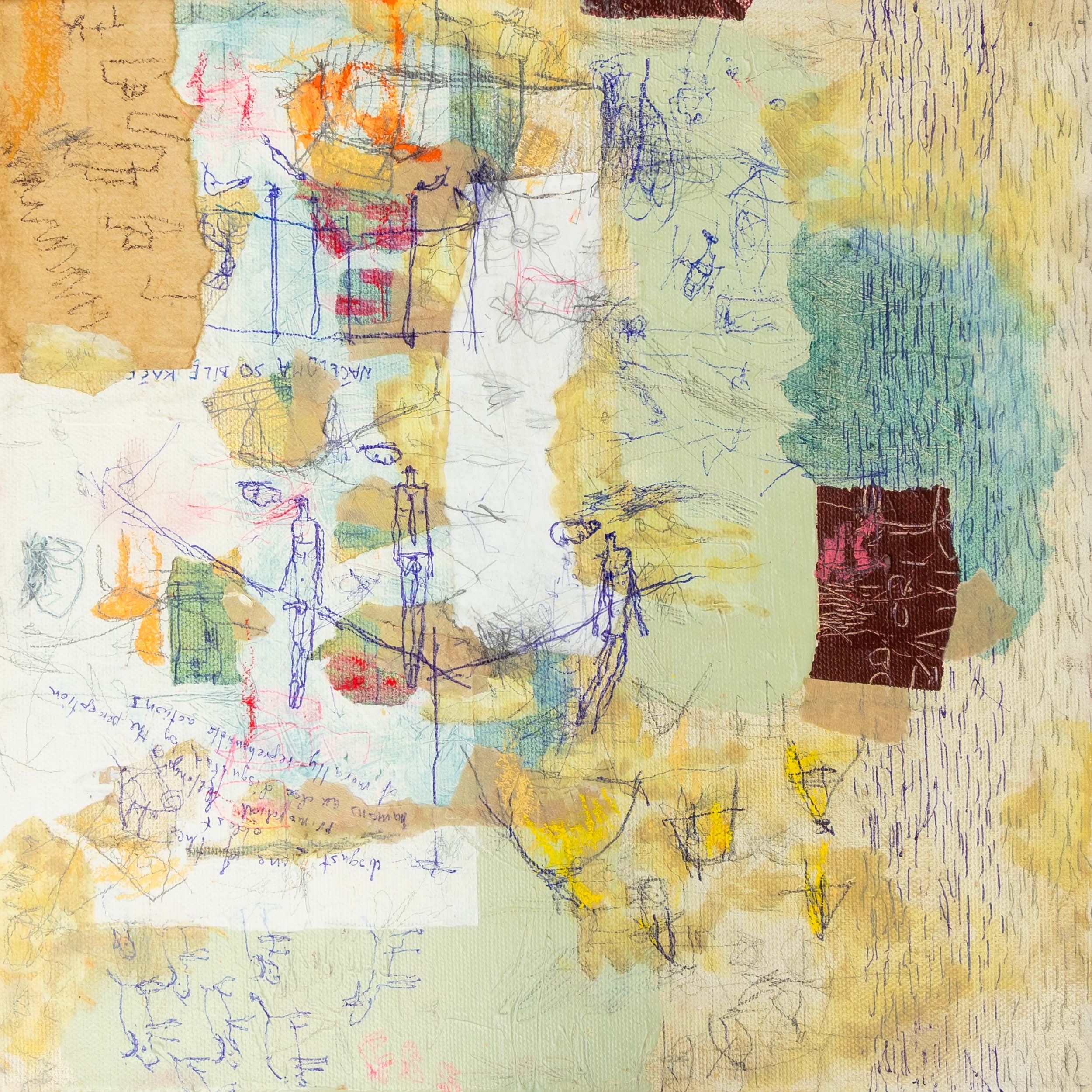
Patrik Dvorščak,
“We Celebrate the General Dismemberment of Reason II “organises drawing, handwriting and torn collage into distinct zones of activity, set within a muted, vintage palette of ochre, sage, teal and deep maroon. At its centre, three slender figures in blue ink hang between taut lines, forms that began in a dream of people stuck in mud. Fragments of text in Slovenian and English, some of them upside down, run through the surface without ever becoming fully readable. Rather than arriving all at once, the image asks the eye to travel from zone to zone, like a floor plan for an imagined installation. Patrik Dvorščak’s collective “we” shifts the work between private interior and shared social space, letting its unease surface slowly.
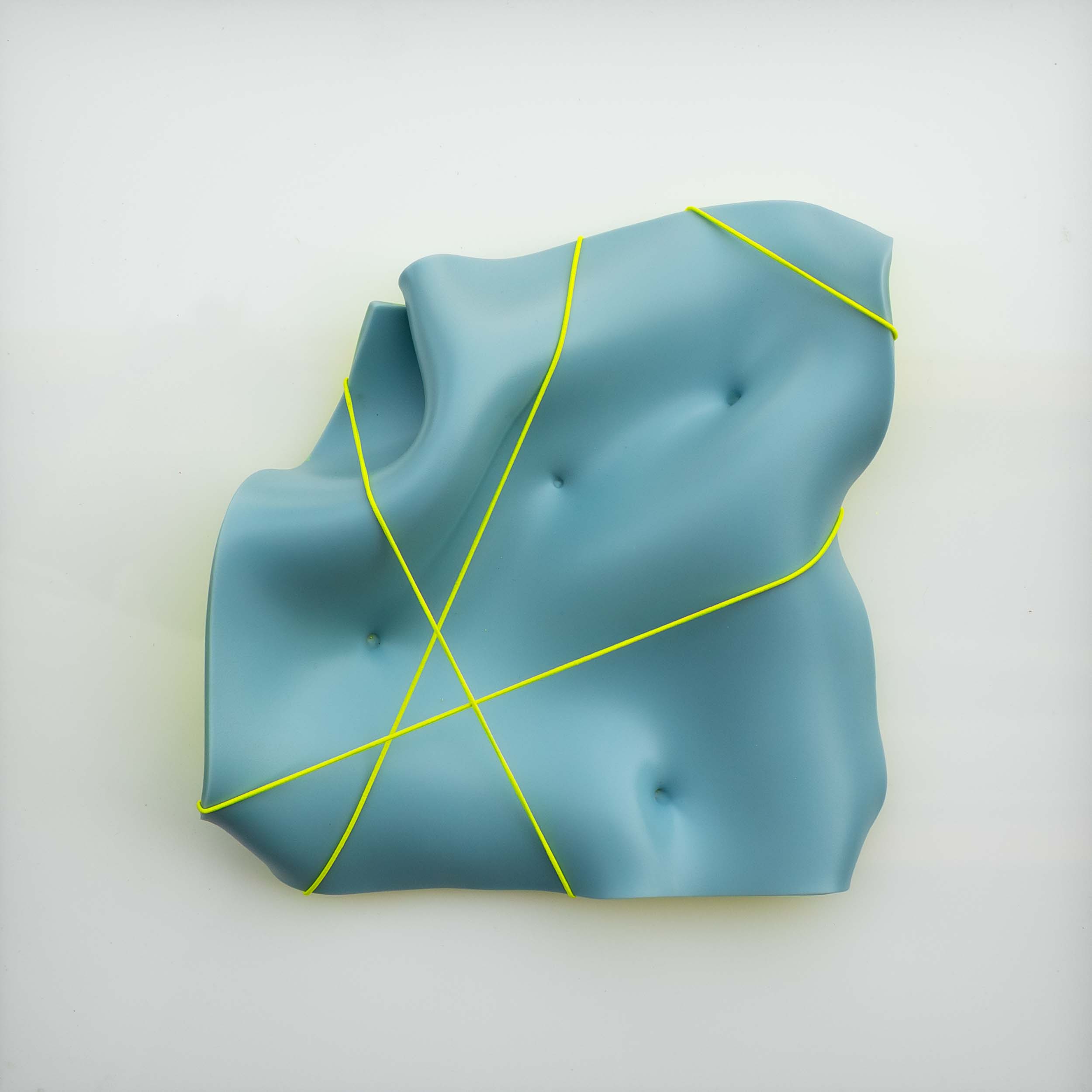
Lisa Pettibone,
Folded glass held in tension by string, as though the material is being pulled toward collapse. The fold has already taken shape through the glass’s own process — the string calls attention to that pressure rather than causing it. A quiet study in restraint and resistance.
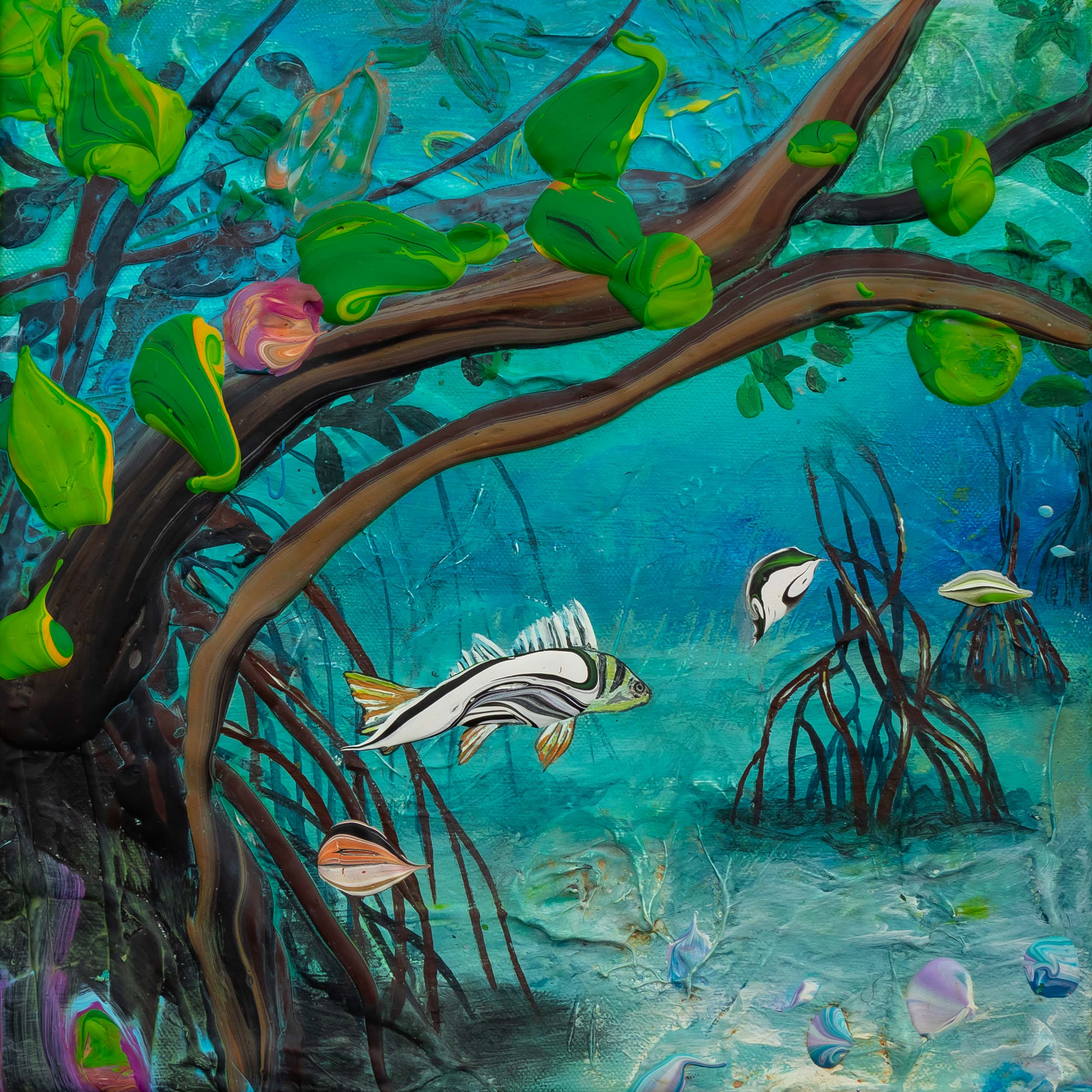
Tarik Chebl,
Tarik Chebli’s Mangrove places a small fish within a layered underwater environment of branching roots, saturated blues, and thick green foliage. The composition is built through depth: dark root systems enter from the edges, the fish holds the centre, and quieter passages of water and vegetation recede behind it.
The painting moves between observation and invention. Some details feel closely noticed — the direction of the fish, the structure of the roots, the shifting water — while other passages remain more ambiguous, allowing the surface itself to suggest organic matter, movement, and density.
Chebli’s work often imagines nature as a world apart from human presence. In Mangrove, that world feels active and self-contained: a small ecosystem in which the central creature and its surrounding habitat belong to the same visual rhythm.
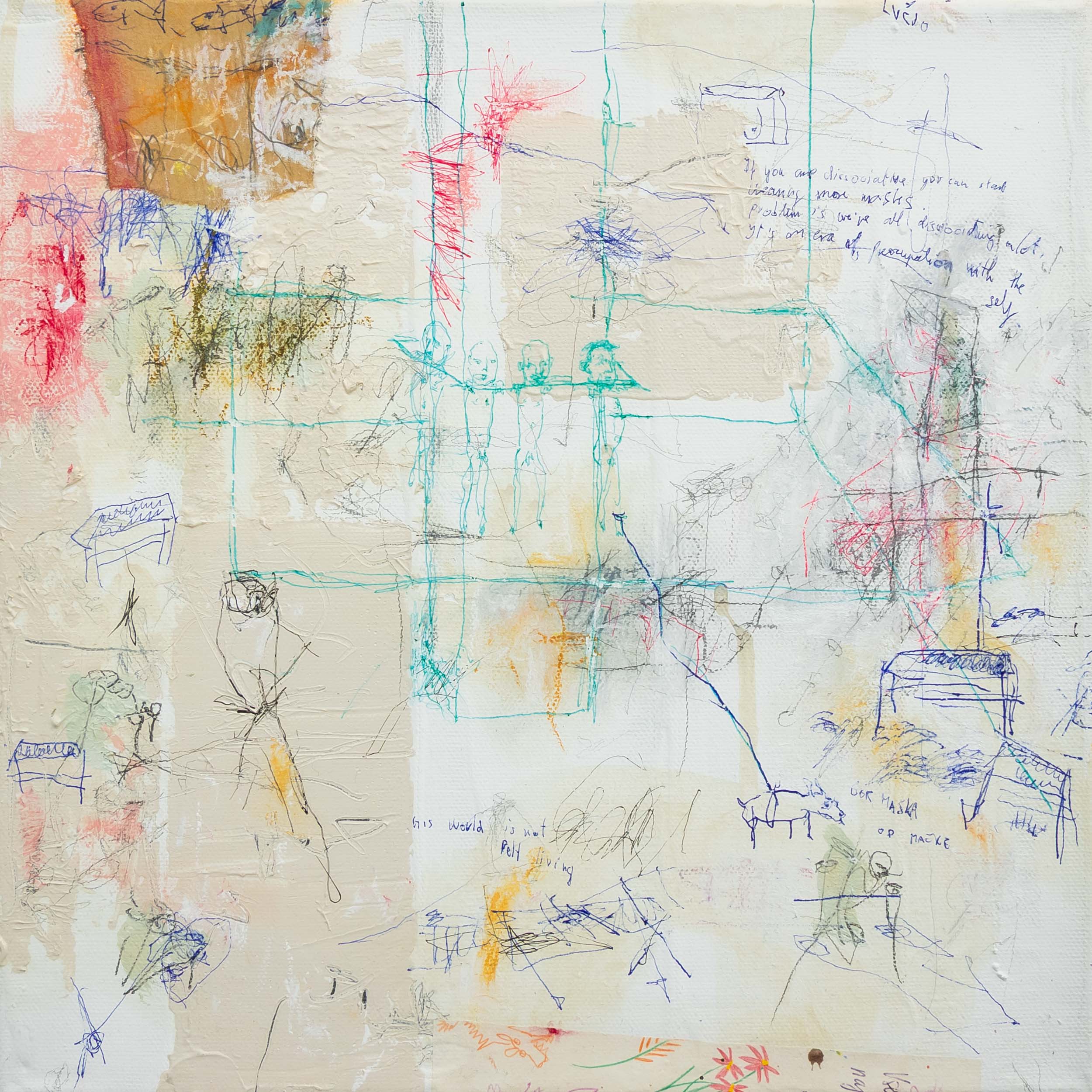
Patrik Dvorščak,
“Antinomy of Reason” unfolds across a pale, open surface where handwritten thoughts, loosely drawn objects and scattered marks surround a central group of figures. The title refers to a contradiction between ideas that each appear logically valid—a tension echoed in the painting’s shifting relationship between order and disorder. A turquoise architectural framework gives the composition structure, while scratches, overlapping lines and partially erased forms create an intimate psychological space in which memory, observation and competing thoughts coexist.
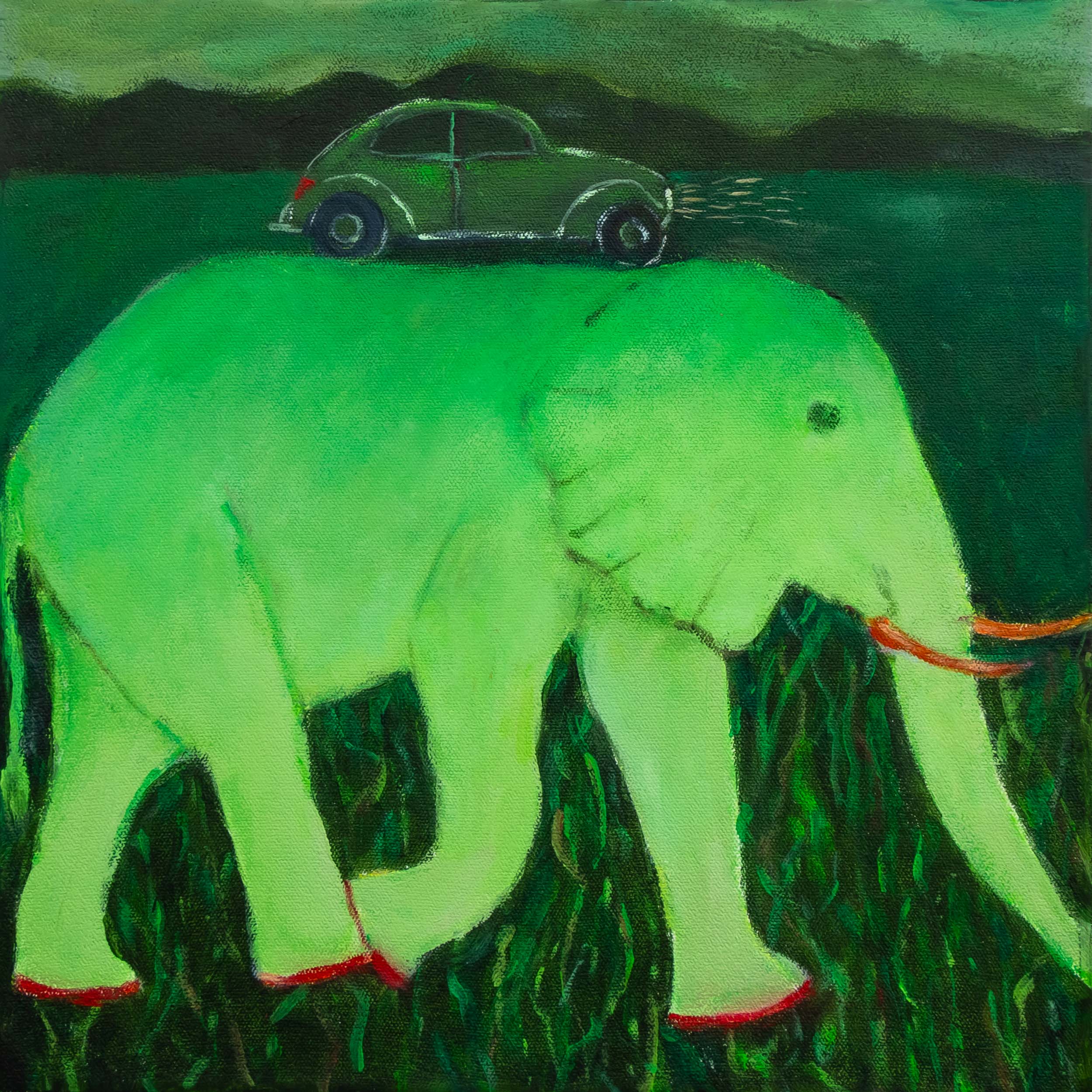
Diana Hyslop,
In The Silence of the Elephant, a Volkswagen Beetle sits atop the elephant’s back, its rounded silhouette echoing the animal’s form as both move in the same direction. Yet the pairing also creates a striking contrast between the implied noise of the car and the elephant’s near-silent passage. Drawn from Diana Hyslop’s memories of elephants arriving unexpectedly in the bush at dusk, the fluorescent-green scene balances wonder with latent danger, while the cropped trunk and tusk suggest a story continuing beyond the canvas.