
Within chess, the Bongcloud Attack is an unconventional opening that consists out of the moves 4e, e5, Ke2. It’s regarded as a joke that completely goes against the grain, but you could also say that it’s inventive, surprising, with a playful tongue-in-cheekness that is reminiscent of that of the ardent chess player Marcel Duchamp. What it comes down to is that the king is immediately put into a vulnerable position, without a further possibility to castle. But in a sense he’s therefore also immediately much more active as he’s obliged to actively enter the game from the start, rather than hide and be protected, obliged to sticking his neck out so to speak. Maybe the king can thus be seen as a metaphor for a daring collector.
Salon’s proposition to produce a collection of art works, each measuring 30×30 cm, to both sustain artists, attract a new generation of collectors and create a platform for development and discussion, is in my view, just as left-field as the Bongcloud Attack in chess. This online exhibition doesn’t have the 64 fields of a chess board, but only 12. Their square format and formation nevertheless reminded me of it. My eclectic choice of artists and artworks from Salon’s collection enter in a conversation that can be compared to Duchamp’s remark in how the play of chess is completely in one’s grey matter and in fact a form of art.
Without any actively moving pieces, nor competition, the selected works enter in a playful exchange The Bongcloud Attack thus serves both as a metaphor for Salon’s set up and as a curatorial idea that chimes well with my usual approach of making exhibitions in which an absurd title is often an important point of departure.
My selection of the works of Seth Bausermann (USA), Tarik Chebli (FRA), Patrik Dvorščak (SVN), Tommaso Fattovich (ITA), Diana Hyslop (ZAF), Sonia Martins Mateus (PRT), Norman O’Flynn (ZAF), Lisa Pettibone (USA) and Wonder (ZAF), lets them interconnect, temporarily coming together, moving around and entering in discussion, open to further discovery and exploration. It’s a highly personal selection in which I was inspired by the rich interplay with the abstract and figurative, the strong layering of text, materials, cultural or personal references, titles, both in the artists’s individual work and between them.
Of some artists I selected multiple works, such as of Diana Hyslop who opens and closes the selection. Her woman is watching with watchful Picassoesque eyes whereas her ‘From Above’ brings different ways of being and seeing together in different planes. In-between the work of the other selected artists plays hide and seek between abstraction and figuration, text and image, playful despair, light mockery maybe that’s nevertheless serious.
The unexpected internal collisions lead to new visions and ideas that I feel also lie at the heart of Salon’s new enterprise. A true Bongcloud Attack.
Edith Doove, Rouen, 18 August 2026

Curated By Edith Doove, PhD
Ends: October 31 9:00 pm Paris Time
Within chess, the Bongcloud Attack is an unconventional opening that consists out of the moves 4e, e5, Ke2. It’s regarded as a joke that completely goes against the grain, but you could also say that it’s inventive, surprising, with a playful tongue-in-cheekness that is reminiscent of that of the ardent chess player Marcel Duchamp. What it comes down to is that the king is immediately put into a vulnerable position, without a further possibility to castle. But in a sense he’s therefore also immediately much more active as he’s obliged to actively enter the game from the start, rather than hide and be protected, obliged to sticking his neck out so to speak. Maybe the king can thus be seen as a metaphor for a daring collector.
Salon’s proposition to produce a collection of art works, each measuring 30×30 cm, to both sustain artists, attract a new generation of collectors and create a platform for development and discussion, is in my view, just as left-field as the Bongcloud Attack in chess. This online exhibition doesn’t have the 64 fields of a chess board, but only 12. Their square format and formation nevertheless reminded me of it. My eclectic choice of artists and artworks from Salon’s collection enter in a conversation that can be compared to Duchamp’s remark in how the play of chess is completely in one’s grey matter and in fact a form of art.
Without any actively moving pieces, nor competition, the selected works enter in a playful exchange The Bongcloud Attack thus serves both as a metaphor for Salon’s set up and as a curatorial idea that chimes well with my usual approach of making exhibitions in which an absurd title is often an important point of departure.
My selection of the works of Seth Bausermann (USA), Tarik Chebli (FRA), Patrik Dvorščak (SVN), Tommaso Fattovich (ITA), Diana Hyslop (ZAF), Sonia Martins Mateus (PRT), Norman O’Flynn (ZAF), Lisa Pettibone (USA) and Wonder (ZAF), lets them interconnect, temporarily coming together, moving around and entering in discussion, open to further discovery and exploration. It’s a highly personal selection in which I was inspired by the rich interplay with the abstract and figurative, the strong layering of text, materials, cultural or personal references, titles, both in the artists’s individual work and between them.
Of some artists I selected multiple works, such as of Diana Hyslop who opens and closes the selection. Her woman is watching with watchful Picassoesque eyes whereas her ‘From Above’ brings different ways of being and seeing together in different planes. In-between the work of the other selected artists plays hide and seek between abstraction and figuration, text and image, playful despair, light mockery maybe that’s nevertheless serious.
The unexpected internal collisions lead to new visions and ideas that I feel also lie at the heart of Salon’s new enterprise. A true Bongcloud Attack.
Edith Doove, Rouen, 18 August 2026
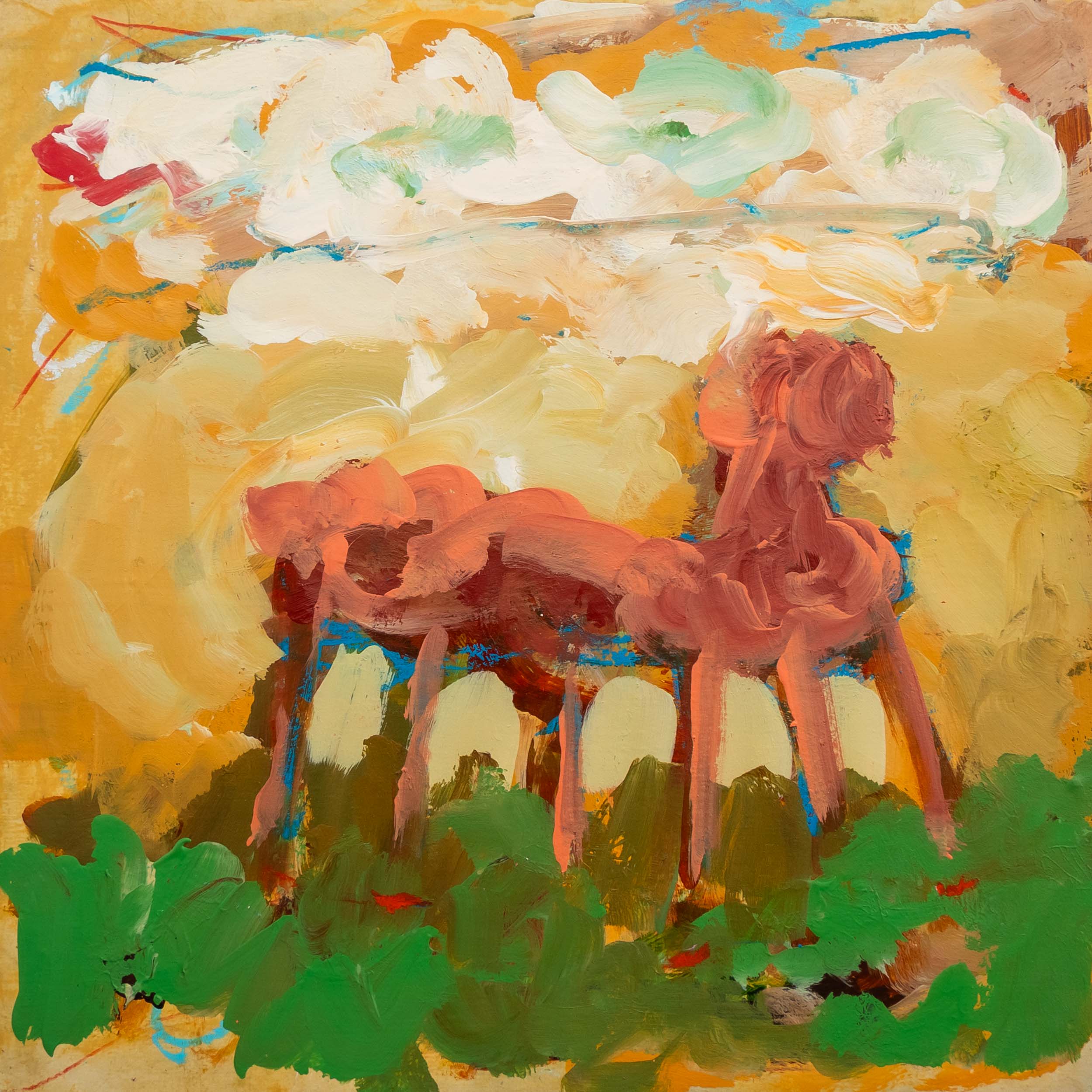
New Pastures #5 is part of Seth Bauserman’s ongoing series drawing on images taken from the artwork of his young daughters. Working with acrylic paint and pastel on transparent Kitakata paper over wood panel, Bauserman layers and abstracts these source images to explore innocence, memory, time, and familial identity across generations.
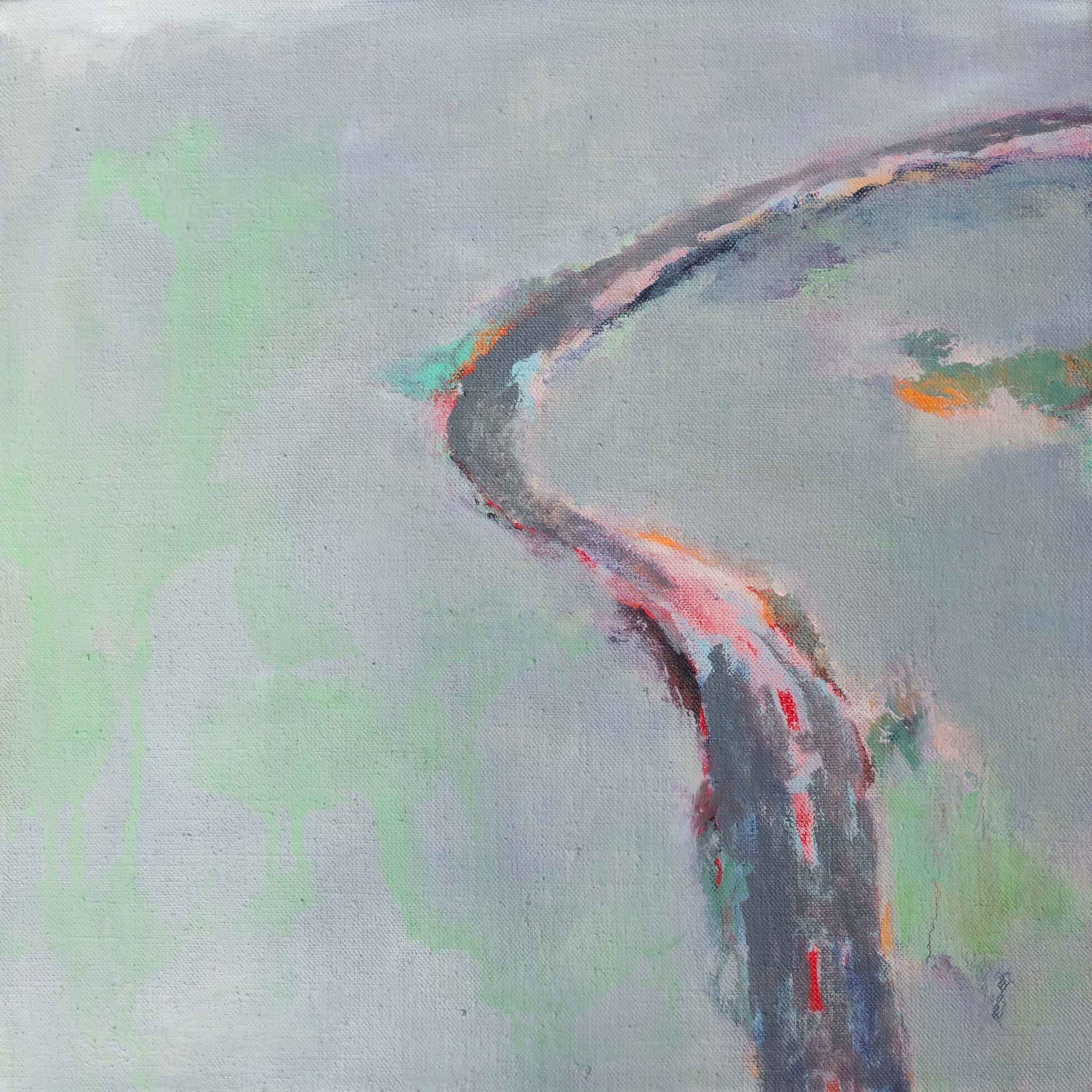
“In The Curve”, a bending road draws the eye into the distance before beginning to blur and break down. Wonder painted this landscape from memory after travelling through the Karoo and Eastern Cape, working not from a photograph or drawing, but from what remained afterwards. The curve gives the painting a clear sense of movement, while the surrounding haze makes the scene feel less like a fixed place than something being recalled—its beauty carrying a subtle undercurrent of uncertainty and exposure.
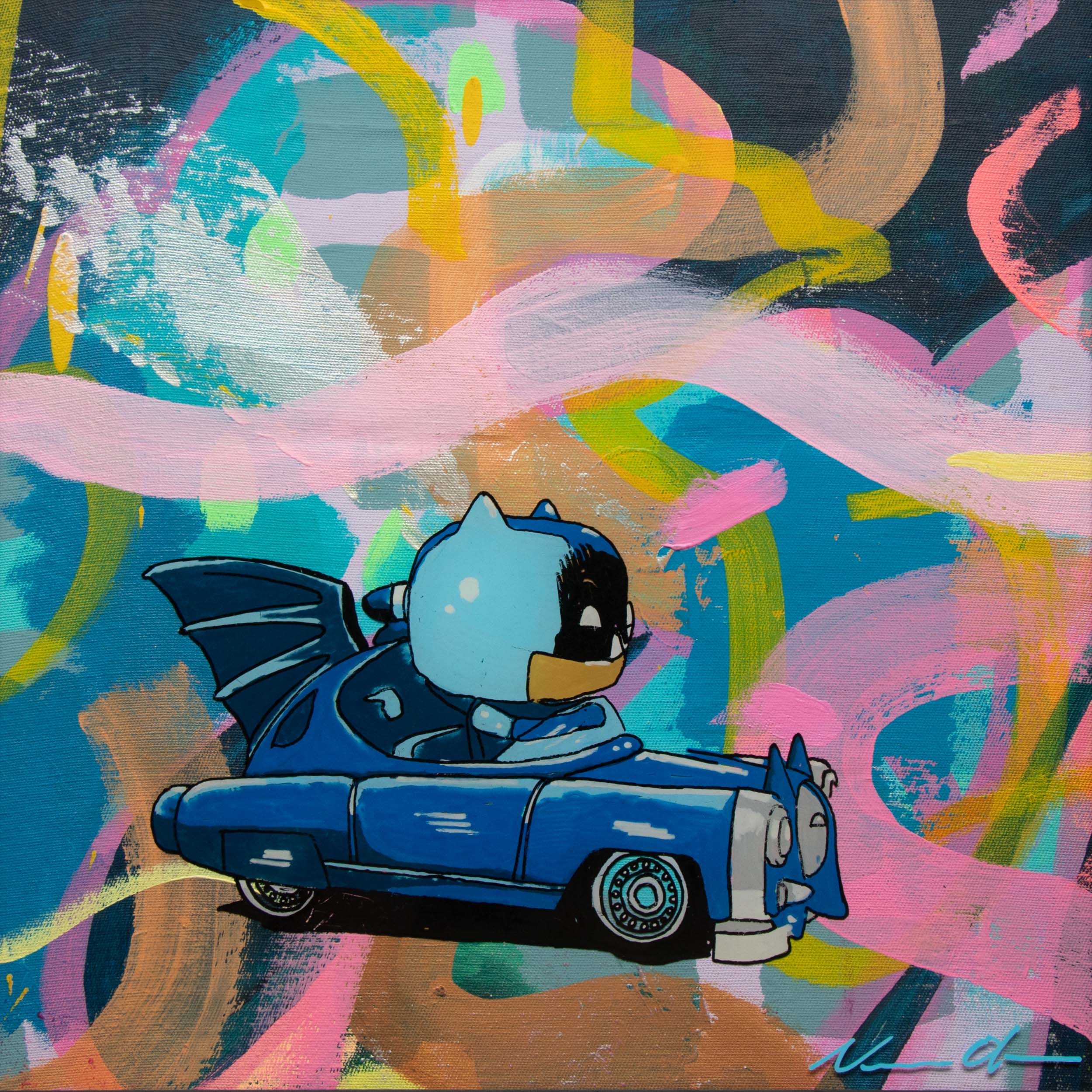
In “The Batmobile”, a toy-like Batman is folded into the form of his equally toy-like vehicle, becoming a comic image of his own. Painted in Norman’s intricate reverse-plexiglass technique, the familiar cultural icon is lifted out of context and set against loose, swirling colour. The result is playful and humorous, but also wonderfully strange—creating the kind of visual “noise” Norman uses to disrupt familiar images and send the viewer towards unexpected associations.
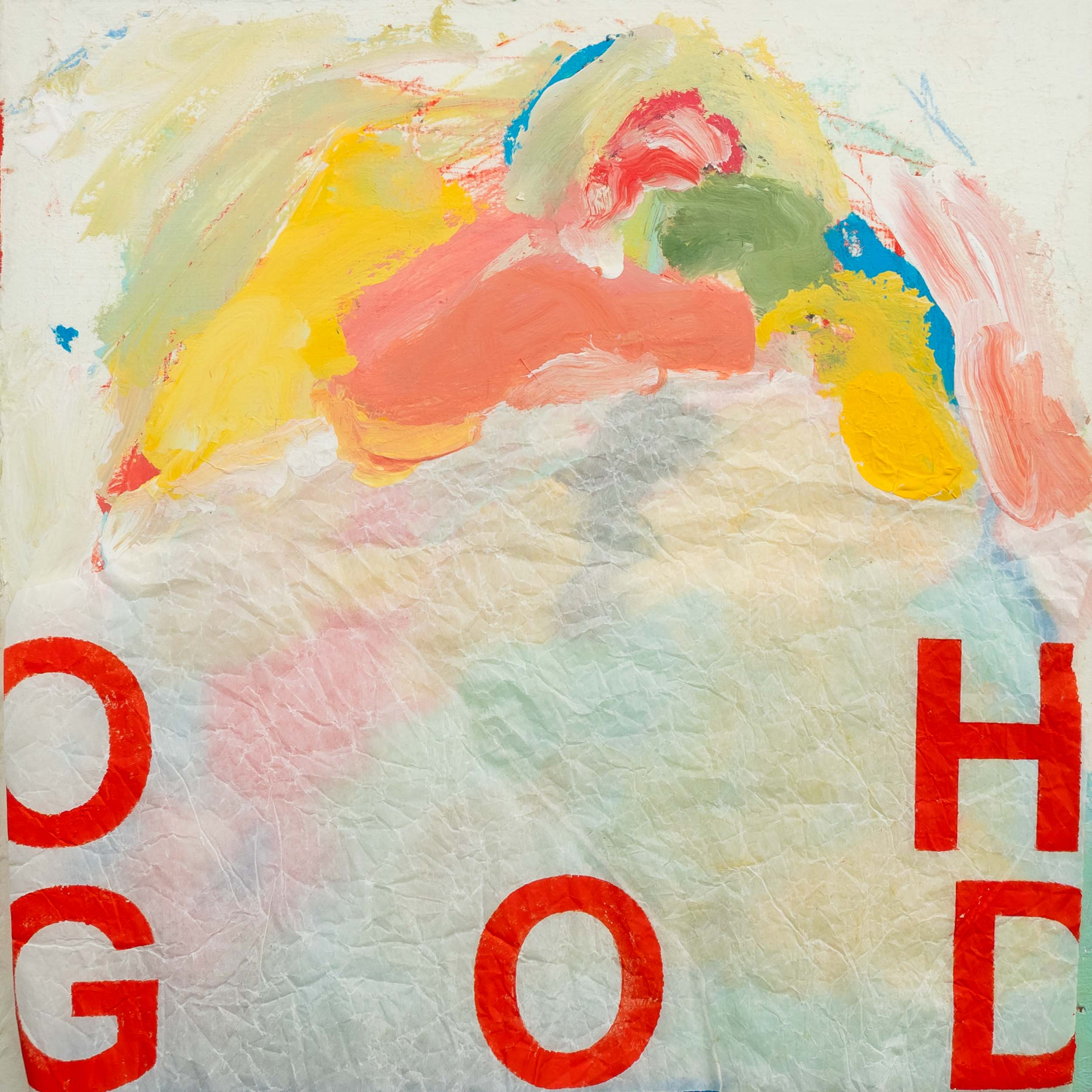
Guttural Prayer / OH GOD layers graphic text over an acrylic form drawn from a sketchbook page by Seth Bauserman’s two-year-old daughter. Made with transparent glassine and mulberry paper, the work uses layering to bring ideas of childhood innocence, memory, mortality and familial identity into tension with a distinctly adult perspective.
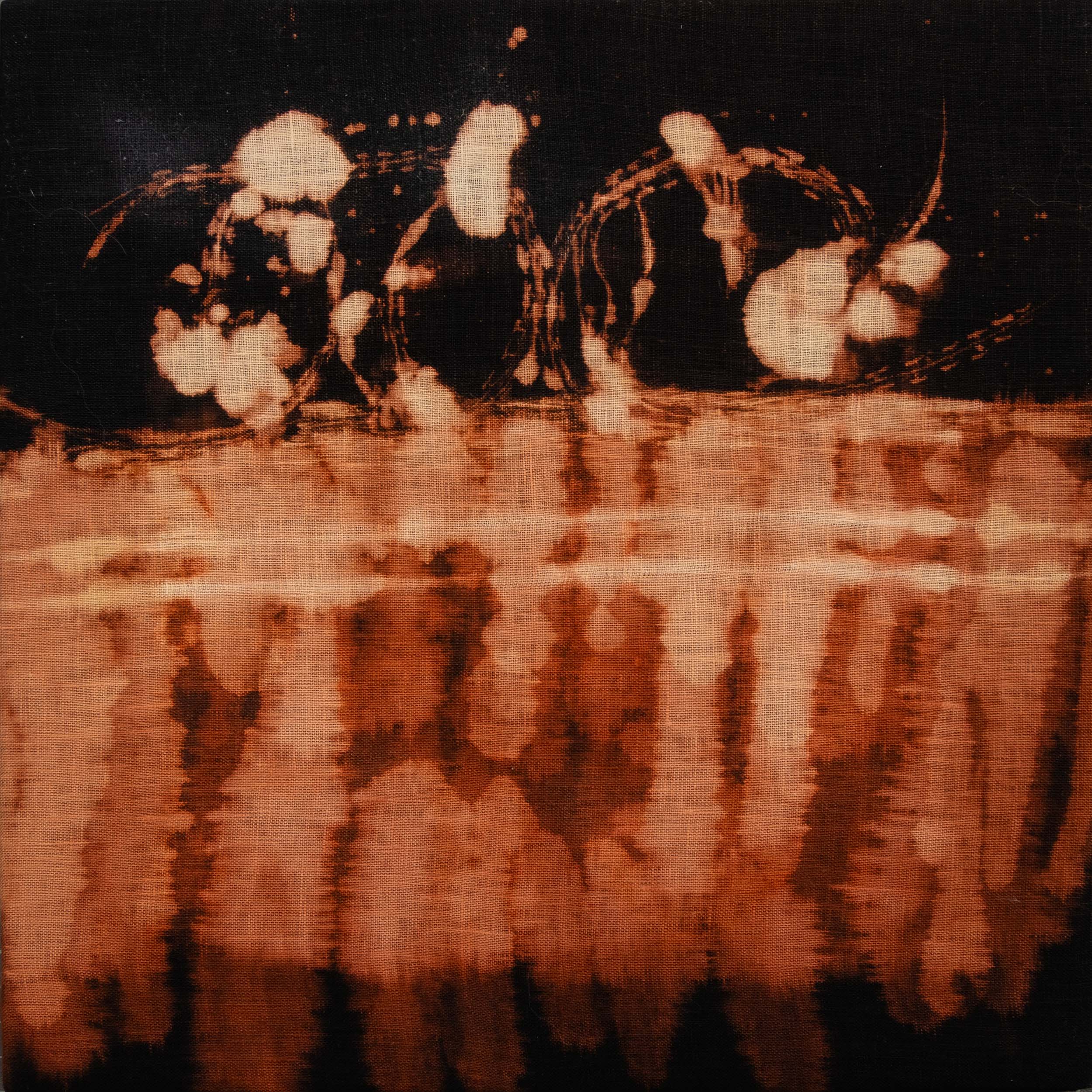
Sonia Martins Mateus’ Plastic Birds is made through painting bleach on black linen, where the image is revealed by removing, biting into, and transforming the surface rather than adding colour to it.
The work holds a compressed, frontal space. Pale ochre forms rise out of the dark ground, while looping, wire-like marks and a dense horizontal structure create a feeling of blockage or containment. The black remains active throughout the image, so that even the areas of light seem to carry shadow beneath them.
Across Martins Mateus’ practice, landscape is not only a place to look into, but a structure shaped by memory, territory, displacement, and material force. In Plastic Birds, that question becomes direct: the painting offers an image, but also resists entry.
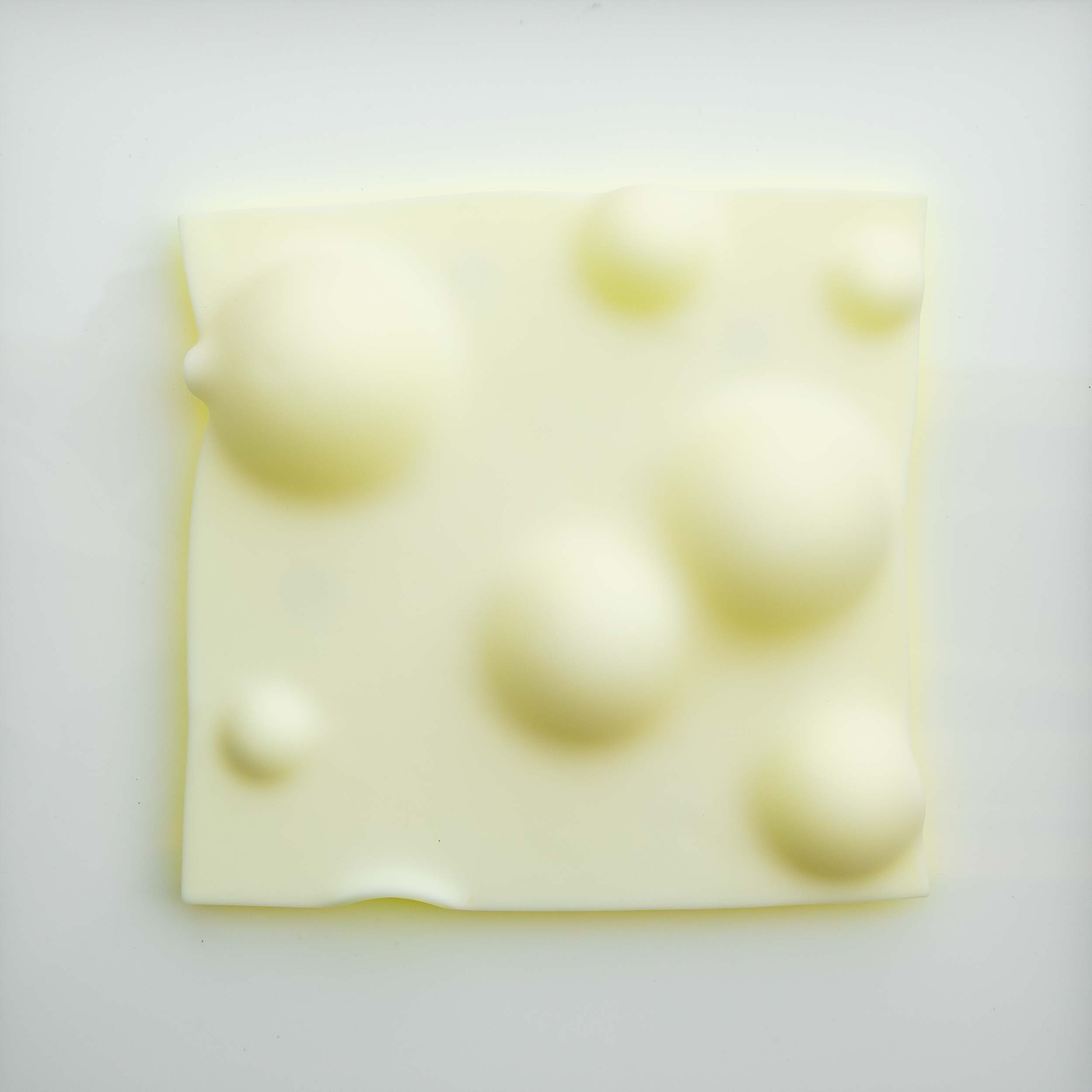
Glass forms rise from the surface as if pressing through from beneath, shaped by the memory of heat and pressure. A fluorescent yellow backing casts a reflected glow, giving the colour a felt, atmospheric presence. The work shifts with the viewer’s position — light and shadow revealing new depths as one moves around it.
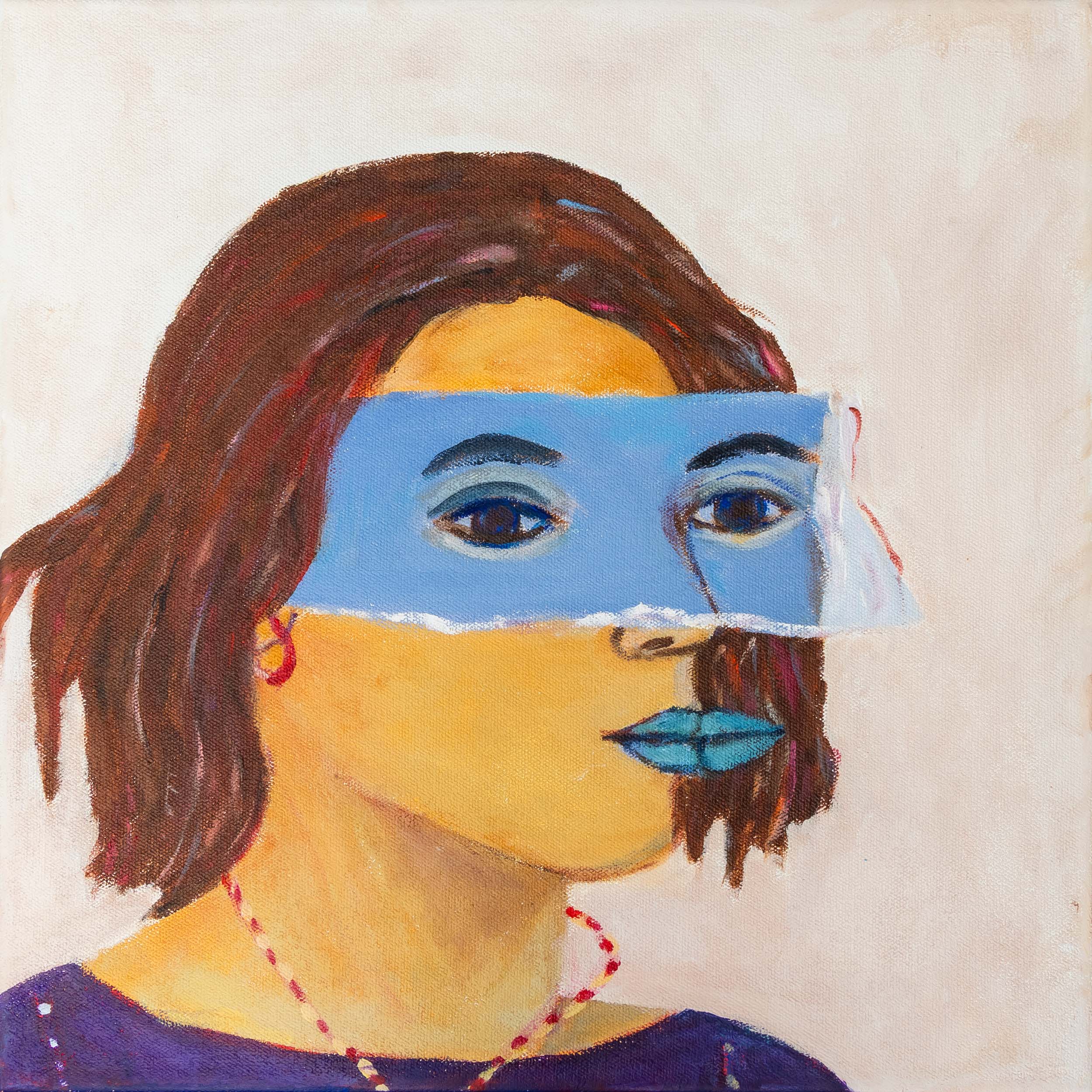
“Watching” began as a portrait of a woman in Diana’s studio, but the face has been fragmented and rearranged into something closer to a painted collage. Its cut-out-like forms recall magazine imagery, Dada composition and Cubist portraiture, while the flashes of red in the lips and nails lend the figure a character that feels at once coy and slightly cruel. There is also something intriguingly self-directed in the gesture—as though the subject is absorbed in the act of watching herself.
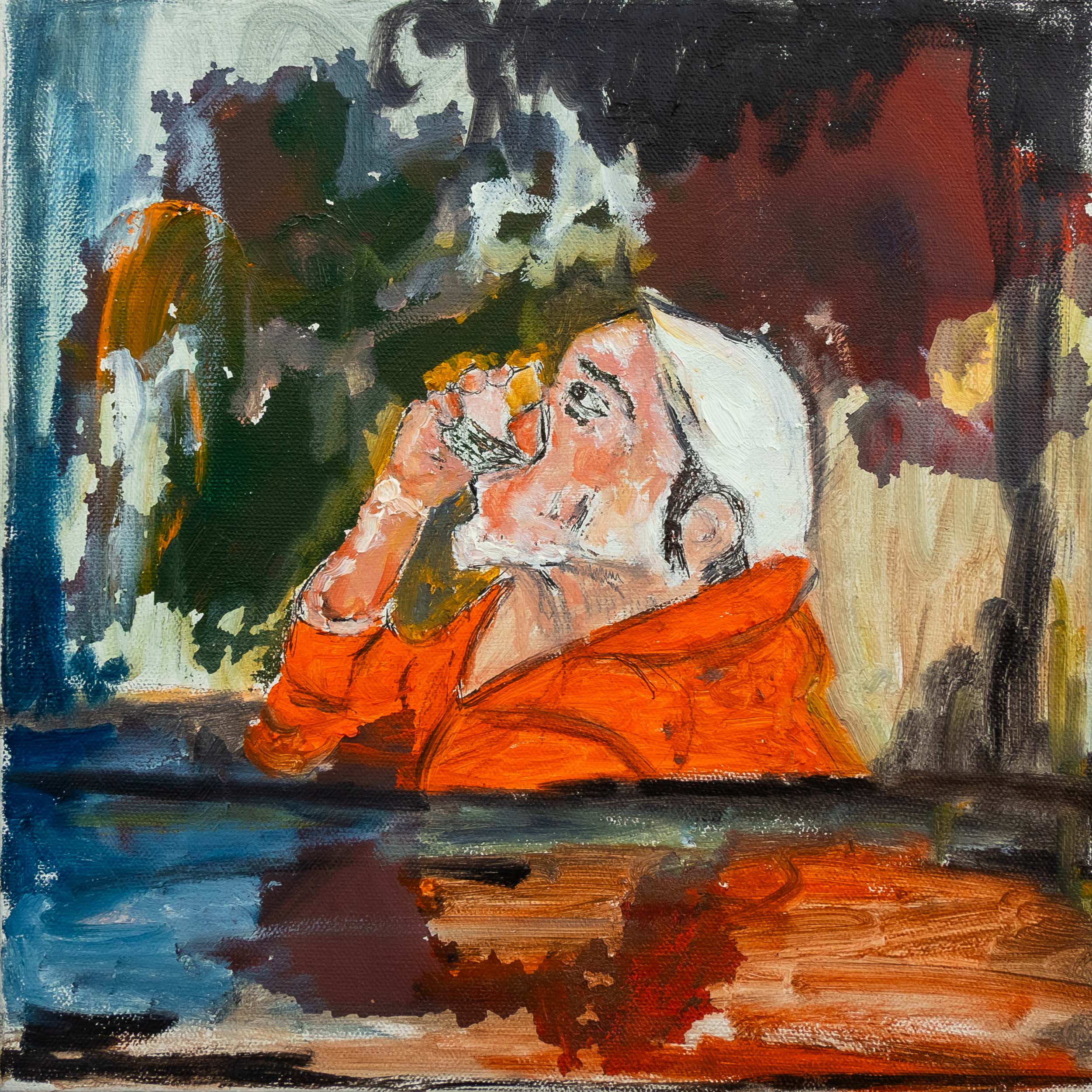
Osteria II is built through layers of addition and removal, beginning with an older oil painting partially covered in white acrylic. Tommaso then draws the figure in pencil, lifts sections of the acrylic with industrial tape to reveal the earlier painting beneath, and adds further oil paint to soften and disrupt the boundaries between figure and background. The result is a compressed, unstable space in which the seated figure feels both present and partially dissolved, hovering between observation and memory.
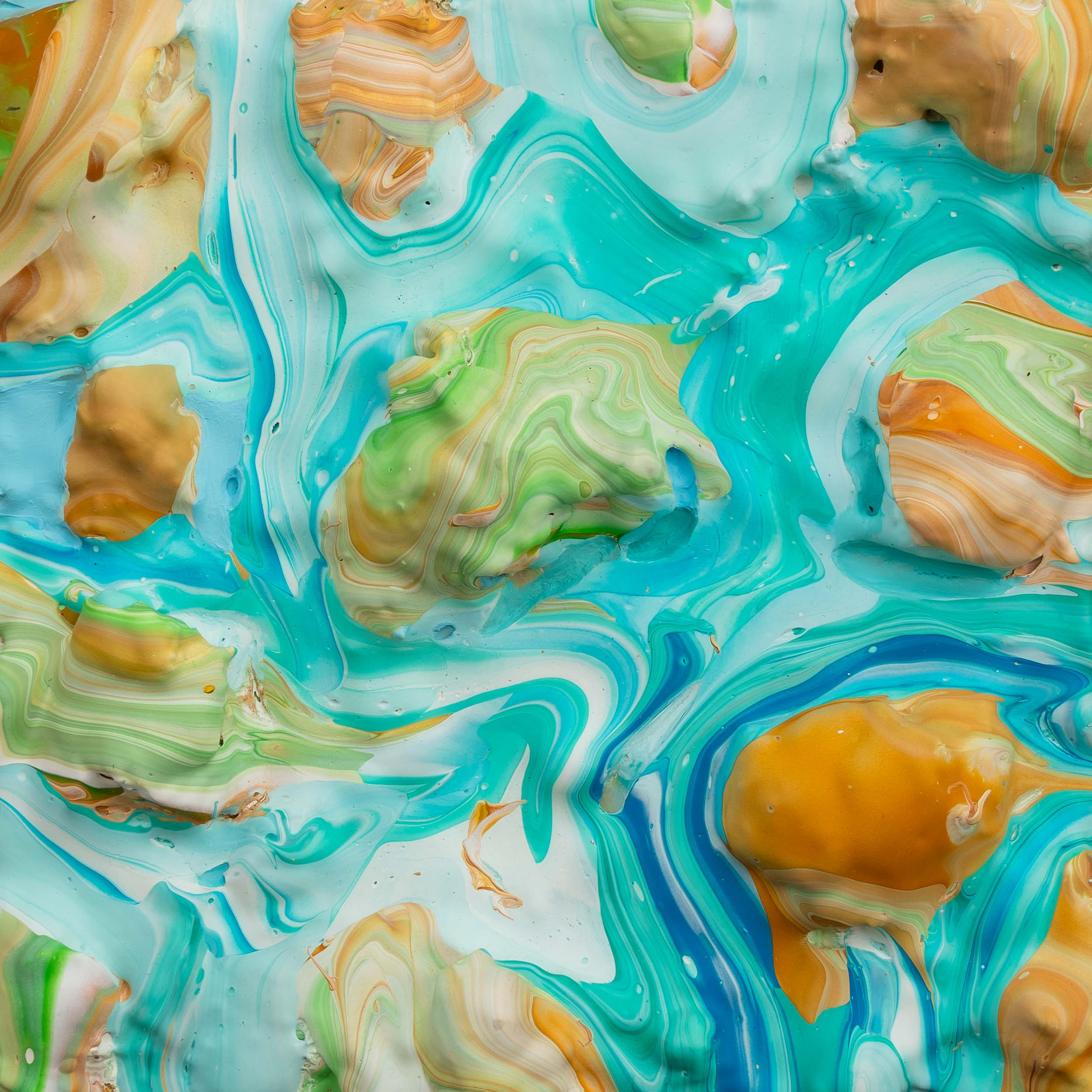
In Island Fragment, Tarik Chebli moves toward a more abstract and object-like language. Poured and accumulated paint creates a dense, topographical surface, where colour and material seem to settle into islands, channels, and geological formations.
Rather than depicting nature directly, the work approaches it through texture, mass, and viewpoint. Seen almost from above, the painting suggests a terrain in formation: part image, part relief, part imagined fragment of an ecological world.
This material intensity sits at the centre of Chebli’s practice, where nature becomes a way to explore paint as substance — layered, physical, and suggestive of mud, water, bark, vegetation, and shifting ground.
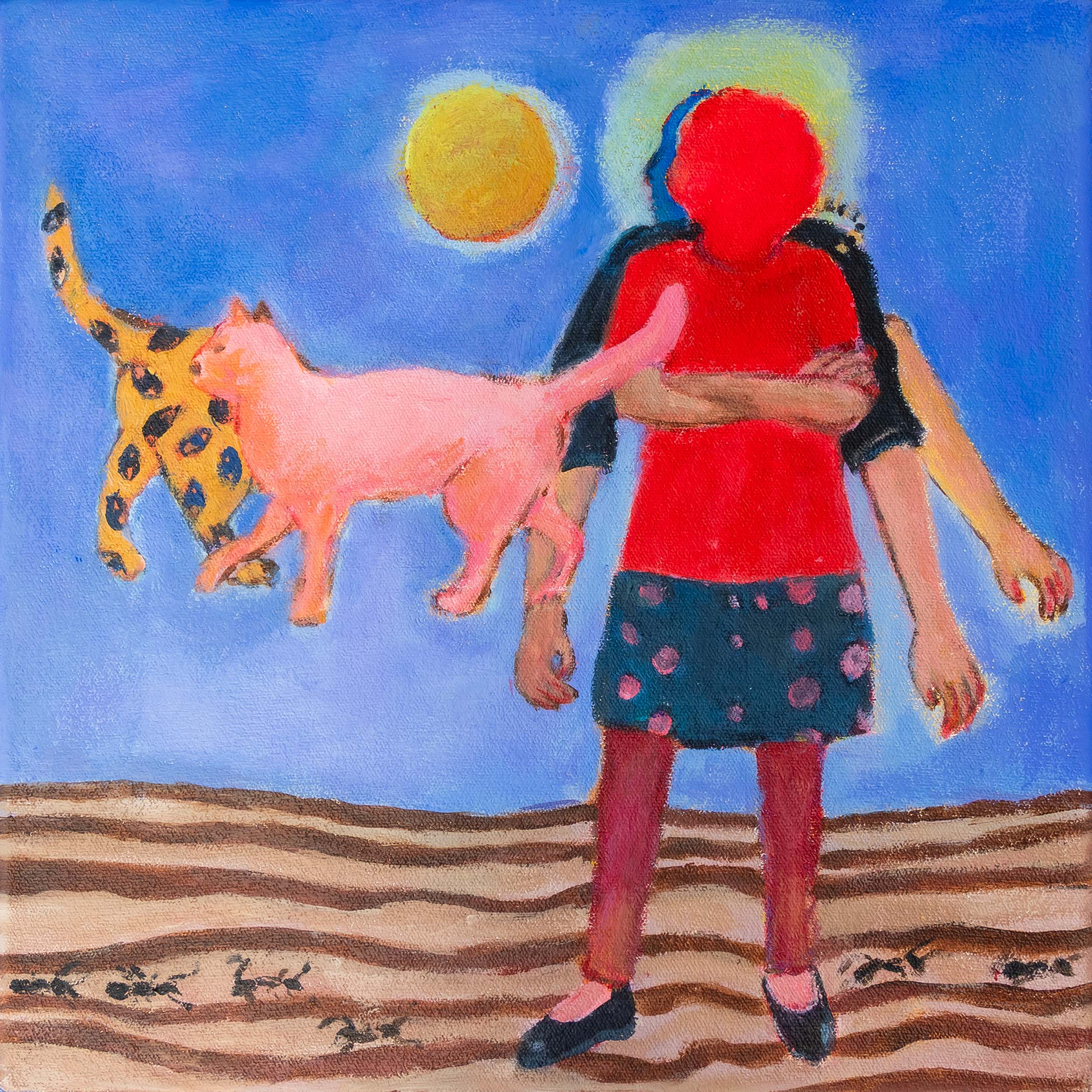
In “From Above”, Diana brings human figures, cats, leopard markings, repeated eyes and protective presences into a composition that seems to occupy several pictorial planes at once. Like a storyboard, the painting offers fragments of a narrative without telling us precisely how they fit together. The eye moves continually between its characters and symbols, discovering relationships that remain open to interpretation—and may shift each time we return to the work.
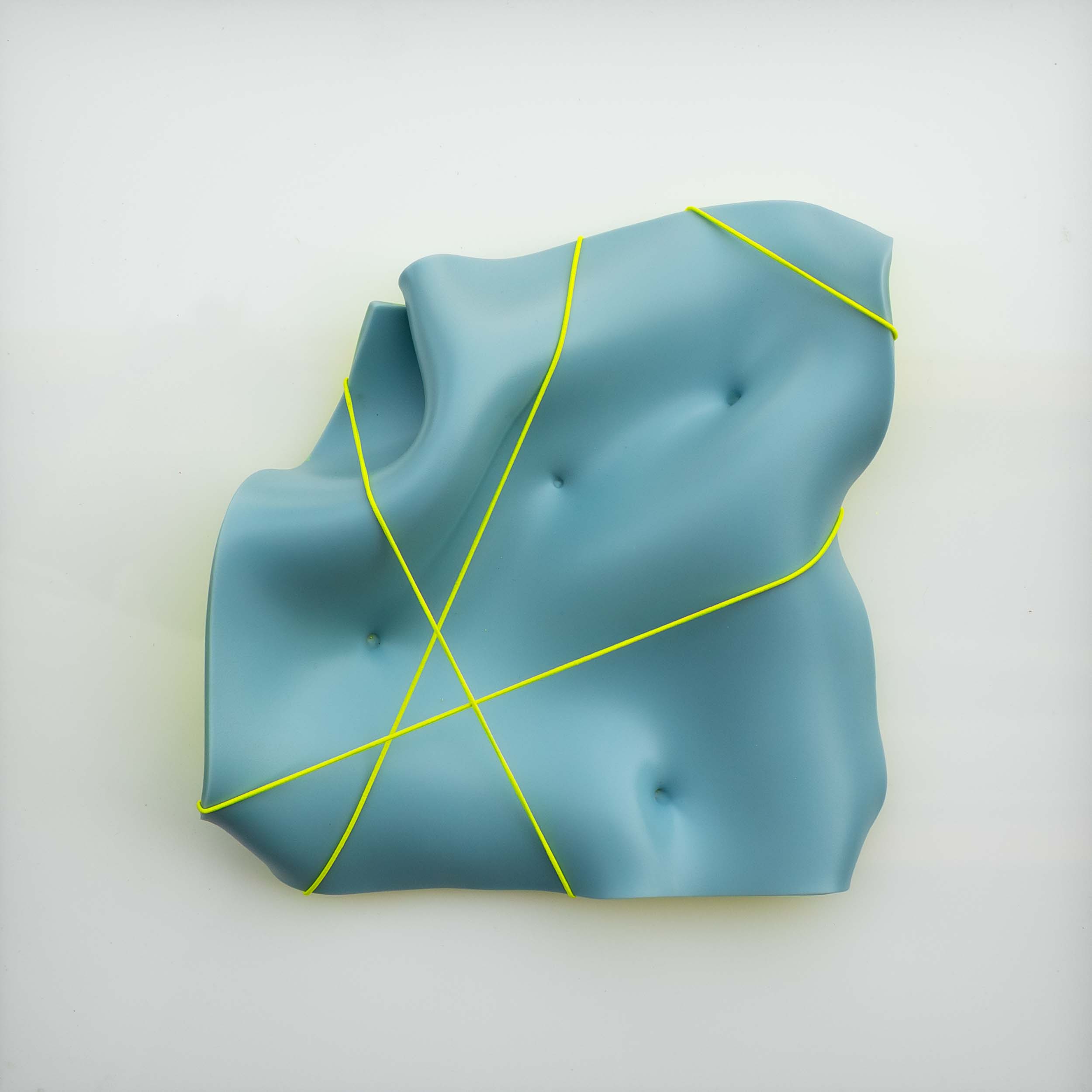
Folded glass held in tension by string, as though the material is being pulled toward collapse. The fold has already taken shape through the glass’s own process — the string calls attention to that pressure rather than causing it. A quiet study in restraint and resistance.
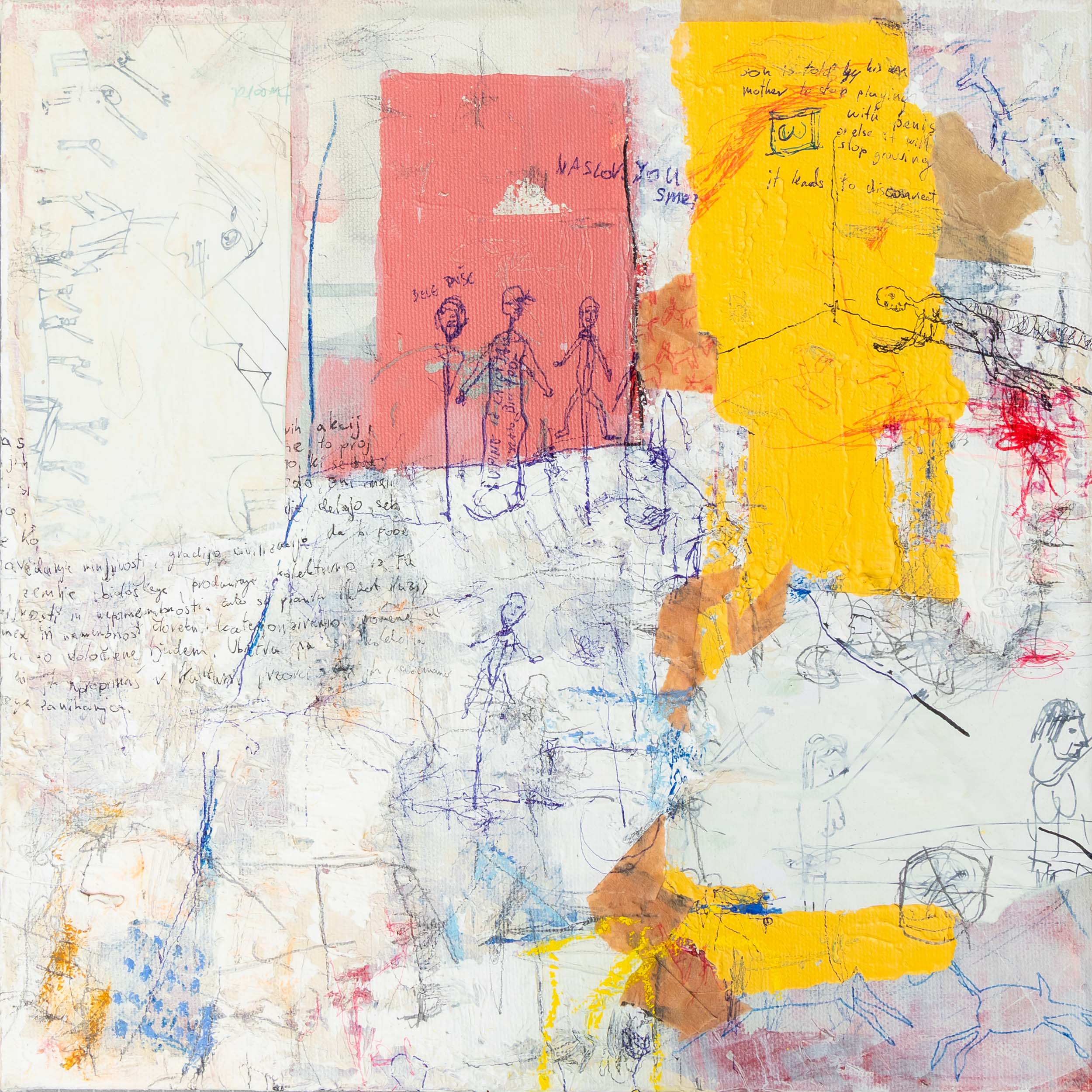
In “A self-structured disordering”, handwritten text, blocks of colour and attached paper accumulate across the surface, creating the feeling of thoughts gathering faster than they can be resolved. Some of the Slovenian writing even appears to spill beyond the composition’s edge. Whether or not we can read it, the text has a presence of its own—functioning as language, image and rhythm while drawing us into a fragmented space shaped by uncertainty, intuition and the unconscious.
To give collectors the peace of mind to follow their instincts, Salon offers a 30-day return policy, as well as an exchange-at-any-time policy, so collectors can buy with confidence while still having flexibility if a work is not quite right for their space or collection.
Once purchased, works are prepared and shipped promptly. Delivery usually takes 3u20135 working days, depending on where in the world you are. Each artwork is secured by an Arteu00efa blockchain-secured NFC tag, which helps guarantee the authenticity and provenance of the work.